Dental Clinic in Turkey: Costs, Safety, Treatments and How to Choose
Medically reviewed by Dr. Furkan Küçük · Last reviewed:

Choosing a dental clinic in Turkey can make private treatment more accessible, but the decision should not be based solely on price, social media photographs, or the shortest advertised package.
Dental treatment is healthcare. The quality of the diagnosis, the suitability of the proposed procedures, the identity of the treating dentist, informed consent, infection control, laboratory work, and follow-up arrangements are all as important as the initial quotation.
This guide explains current base prices at Dr. Furkan Küçük Dental Clinic, the treatments a clinic may provide, how to compare quotations, how to verify a provider, and what to consider before traveling to Istanbul for dental care.
Current Base Prices at Dr. Furkan Küçük Dental Clinic
The following are the clinic’s approved base prices before discounts and special offers:
- Turkish implant: 225 euros per tooth
- German implant: 300 euros per tooth
- Swiss implant: 500 euros per tooth
- Zirconium crown: 140 euros per tooth
- E.max crown: 170 euros per tooth
- Veneer: 200 euros per tooth
- Partner hotel: 55 euros per night
These figures are useful for initial budgeting, but they are not a final treatment quotation.
The final amount depends on your diagnosis, the number of teeth involved, the procedures selected, the materials used, laboratory stages, preliminary treatment, healing requirements, and the services included in your written plan.
Current discounts and personalized offers should be confirmed directly with the clinic.
An implant price is not always the full cost of a replacement tooth
A quoted implant price may refer only to the implant fixture placed in the bone. A complete replacement tooth can also involve:
- Examination and diagnostic imaging
- Tooth extraction
- Bone grafting or sinus treatment
- The implant fixture
- A healing component
- The abutment connecting the implant to the crown
- A temporary tooth
- The final crown or bridge
- Medication and follow-up
- Additional visits or accommodation
Ask the clinic to identify every included and excluded component before comparing its implant price with another quotation.
The same principle applies to veneers, crowns, full-arch restorations, and smile-makeover plans. A lower price per tooth does not automatically produce a lower final bill when preliminary care, temporary restorations, laboratory work, or follow-up are charged separately.
Use the calculator below for an initial estimate. It is not a final treatment quotation.
What Treatments Can a Dental Clinic in Turkey Provide?
A dental clinic in Turkey may offer several types of care, but they should not be treated as interchangeable products.
Examination and preventive care
A proper examination may include a medical and dental history, assessment of the teeth and gums, review of existing restorations, bite evaluation, photographs, and radiographs or three-dimensional imaging when clinically indicated.
Preventive care can include professional cleaning, oral hygiene advice, fluoride treatment, and monitoring for early disease.
Restorative dentistry
Restorative treatment aims to repair damaged teeth and restore function. It may include:
- Fillings
- Inlays or onlays
- Root-canal treatment
- Crowns
- Bridges
- Replacement of defective restorations
The most attractive-looking treatment is not necessarily the most appropriate. A tooth that can be predictably restored with a filling or partial restoration may not need a full crown.
Cosmetic dentistry
Cosmetic treatment may involve:
- Professional whitening
- Composite bonding
- Veneers
- Tooth-shape adjustments
- Gum-contour planning
- Orthodontic alignment
- A combination of procedures
Cosmetic planning should begin with oral health and function. Active decay, gum disease, infection, unstable restorations, or bite problems may need attention before elective aesthetic treatment.
Dental implants
Dental implants can replace missing teeth or teeth that cannot be predictably maintained. They may support:
- A single crown
- A fixed bridge
- A removable overdenture
- A complete fixed arch
Implant suitability depends on factors such as bone availability, gum health, medical history, smoking, hygiene, bite forces, and the patient’s ability to maintain the restoration.
Extraction and implant placement should not be presented as routine alternatives to preserving maintainable natural teeth.
Complex and full-mouth treatment
Full-mouth rehabilitation may combine crowns, bridges, implants, gum treatment, bite correction, and tooth replacement.
These cases require more than selecting a package or a fixed number of crowns. The dentist should explain the diagnosis for every area, the treatment sequence, alternatives, provisional stages, maintenance needs, and what could change after the in-person examination.
Why Do International Patients Consider Turkey?
International patients may consider Turkey because treatment can be competitively priced and because clinics serving overseas patients may coordinate consultations, appointments, laboratory stages, translation, accommodation, and transfers.
Istanbul is also accessible from many European, Middle Eastern, and international cities.
However, neither location nor price proves that a particular clinic or treatment plan is suitable. Standards, clinical approaches, experience, materials, communication, and aftercare can differ between providers in any country.
The useful comparison is not simply “Turkey versus another country.” It is:
- One diagnosis versus another
- One treatment plan versus another
- One treating dentist’s qualifications and experience versus another’s
- One set of materials and laboratory processes versus another
- One aftercare agreement versus another
- One complete written quotation versus another
How to Verify a Dental Clinic and Treating Dentist
Clinic verification should happen before you pay a substantial deposit or book non-refundable travel.
Check current provider authorization
The Republic of Türkiye Ministry of Health publishes current lists of healthcare providers authorized to serve international health-tourism patients.
Check the provider’s exact legal name, category, and location. Similar clinic names, marketing brands, or intermediary companies can create confusion.
Authorization is an important regulatory check, but it does not guarantee that every proposed procedure is necessary or that a particular outcome will be achieved.
Identify the dentist who will treat you
Ask for the full name of the dentist responsible for:
- Your diagnosis
- Implant surgery
- Root-canal treatment
- Tooth preparation
- Cosmetic design
- Fitting the final restorations
- Follow-up decisions
Do not assume that the person appearing in advertisements will perform every stage.
Ask about the dentist’s qualifications, professional status, experience with the proposed procedure, and role in your case. Where more than one clinician is involved, request a clear division of responsibility.
Ask about the laboratory and materials
For crowns, veneers, bridges, implant restorations, and removable prostheses, ask:
- Which material is proposed?
- Why is it appropriate for this tooth or area?
- Which dental laboratory will make the restoration?
- Is the laboratory internal or external?
- Will you receive material or implant identification records?
- What happens if the shade, fit, bite, or appearance needs adjustment?
A famous brand does not compensate for unsuitable treatment design, excessive preparation, poor laboratory communication, or an unbalanced bite.
Review infection-control and emergency arrangements
The clinic should be able to explain how instruments are cleaned, packaged, sterilized, stored, and traced.
Also ask how the clinic handles:
- Medical emergencies
- Unexpected bleeding or swelling
- Allergic reactions
- Pain outside normal opening hours
- Referral to a hospital or another specialist
- Complications occurring after you leave Turkey
Why a Remote Quote Is Only Preliminary
Photographs, previous radiographs, video calls, and written histories can help a clinic understand your concerns and prepare an initial estimate.
They cannot reliably reveal every relevant clinical factor.
An in-person examination may identify:
- Decay hidden beneath an old restoration
- Gum disease
- Cracks
- Infection
- Insufficient bone
- An unstable bite
- Grinding damage
- Teeth that can be preserved
- A need for orthodontics or gum treatment
- A different number of restorations than originally estimated
For this reason, a responsible remote quotation should explain that the diagnosis, treatment plan, price, and timeline may change after examination and imaging.
A coordinator can help collect information and arrange appointments, but an appropriately qualified dentist should complete diagnosis and definitive treatment planning.
What Happens During Treatment in Istanbul?
Although the sequence varies, a well-planned dental journey normally includes the following stages.
1. Information before travel
The clinic may request:
- Recent radiographs
- Clear photographs
- Previous treatment records
- A list of medications
- Medical conditions and allergies
- Smoking or grinding history
- Your concerns and priorities
- Approximate travel availability
Provide complete and accurate information. Undisclosed medical conditions or medicines can affect surgery, bleeding, healing, anesthesia, and medication choices.
2. In-person examination
The dentist examines your teeth, gums, existing restorations, bite, and any painful or suspicious areas.
Radiographs, scans, photographs, periodontal measurements, vitality tests, or other investigations may be recommended when necessary.
3. Diagnosis and treatment choices
You should receive an explanation of:
- What problems have been identified
- Which problems need treatment
- Which findings can be monitored
- The recommended option
- Reasonable alternatives
- The consequences of postponing or declining treatment
- The risks and limitations
- Expected maintenance and possible future replacement
You should have time to ask questions before irreversible treatment begins.
4. Written quotation and consent
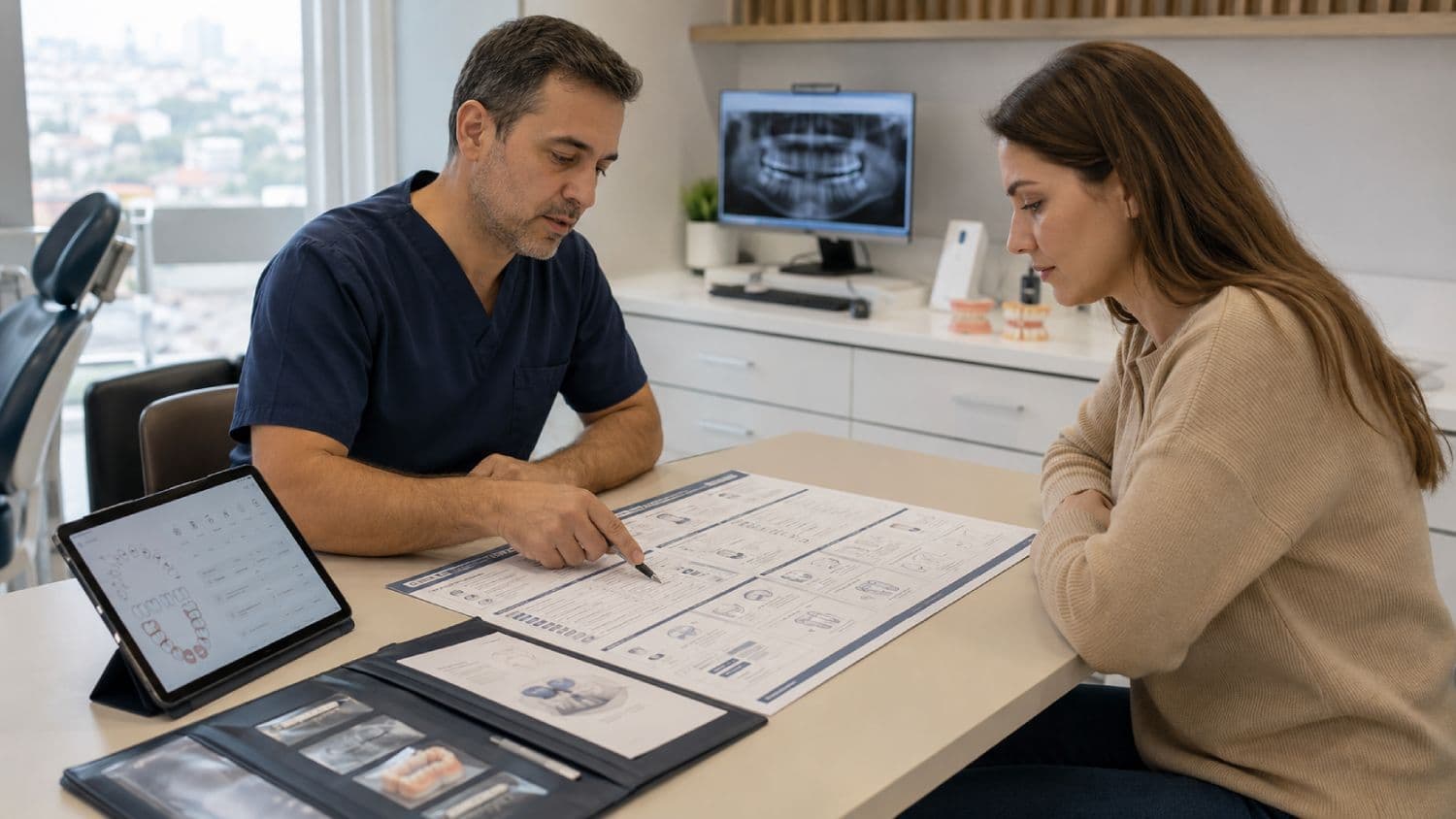
The written plan should align with the diagnosis and specify what will happen to each tooth or treatment area.
Consent is more than signing a form. It is the process of understanding the proposed care, benefits, material risks, alternatives, costs, and uncertainties before making a decision.
5. Preliminary treatment
Decay, infection, unstable gum health, defective restorations, or teeth that genuinely cannot be restored may need to be treated before cosmetic or definitive restorative work.
Adding preliminary procedures can change both the cost and the schedule. These changes should be discussed before the work proceeds.
6. Treatment and laboratory stages
Depending on the case, this may include:
- Tooth preparation
- Implant placement
- Digital scanning or impressions
- Temporary restorations
- Laboratory production
- Healing periods
- Trial fittings
- Shade and shape review
- Bite adjustment
Temporary restorations can protect prepared teeth and help assess appearance and function, but they are not identical to the final restorations.
7. Final fitting and checks
Before final acceptance, the dentist may need to assess:
- Fit
- Contact between teeth
- Bite
- Comfort
- Speech
- Shade
- Shape
- Cleaning access
- Gum response
Do not plan to leave immediately after a major final fitting. Allowing time for review and adjustments can reduce avoidable difficulties after returning home.
8. Discharge and follow-up
Before departure, obtain written aftercare instructions and clarify:
- What is normal during recovery
- What symptoms require professional assessment
- Which foods or activities to avoid
- How and when to clean the treated area
- When follow-up is expected
- Who to contact outside normal hours
- What maintenance is needed at home
How Long Should You Stay in Turkey?
There is no correct length of stay for every patient.
A simple examination, cleaning, filling, or whitening appointment may require relatively little clinical time.
Laboratory-made veneers, crowns, and bridges usually involve several stages, including preparation, scanning or impression-taking, temporary restorations, laboratory production, trial fitting, final placement, and adjustment.
Implants can require surgery followed by biological healing before the definitive restoration is fitted. Some patients may qualify for an immediate temporary restoration, but immediate treatment is not appropriate in every case and does not remove the need for healing and follow-up.
Bone grafting, sinus procedures, gum treatment, orthodontics, and complex full-mouth rehabilitation may require longer treatment periods or multiple visits.
A realistic schedule should include enough time for:
- Examination and diagnosis
- Informed decision-making
- Laboratory work
- Trial fitting
- Bite and comfort checks
- Adjustments
- Early review
- Recovery before travel
The shortest itinerary is not necessarily the safest or most convenient itinerary.
How to Compare Dental Quotations
Two quotations can show very different totals because they may not include the same diagnosis, procedures, components, or services.
Use the following checklist.
Clinical details
The quotation should identify:
- The diagnosis for every tooth or treatment area
- The proposed procedure for each tooth
- Reasonable alternatives
- The option of monitoring or no immediate treatment where appropriate
- Preliminary treatment
- Teeth considered non-restorable and the reason
Restorative details
For crowns, veneers, bridges, or dentures, ask for:
- The number of units
- Material type
- Laboratory information
- Temporary restorations
- Adjustments
- Protective appliances such as a night guard
- Maintenance requirements
Implant details
For implants, ask whether the price includes:
- Implant fixture
- Abutment
- Healing component
- Temporary tooth
- Final crown or bridge
- Extraction
- Bone graft
- Sinus treatment
- Surgical guide
- Imaging
- Medication
- Follow-up appointments
Travel and service details
Ask whether the quotation includes:
- Hotel
- Number of nights
- Airport or clinic transfers
- Translation
- Additional companions
- Medication
- Return visits
- Local follow-up
- Emergency assessment
- Repairs or remakes
Financial details
The written quotation should explain:
- Deposit amount
- Payment schedule
- Accepted payment methods
- Currency
- Refund terms
- Conditions that can change the price
- Warranty conditions and exclusions
- Responsibility for remedial treatment and travel expenses
Do not compare totals until you have confirmed that the quotations cover equivalent treatment.
Conservative Treatment and the “Turkey Teeth” Concern
The phrase “Turkey teeth” is often used online to describe dramatic cosmetic transformations, including cases in which healthy teeth appear to have been heavily reduced.
The country is not the clinical diagnosis. Excessive or unsuitable tooth preparation can occur wherever irreversible treatment is selected without adequate assessment, conservative alternatives, or informed consent.
Veneers and crowns are not the same
A veneer generally covers mainly the visible front surface of a tooth and may be considered for selected aesthetic changes.
A crown covers much more of the tooth. It may be appropriate when a tooth is heavily restored, fractured, weakened, or requires broader structural protection.
Both treatments can require irreversible tooth preparation. The amount depends on the tooth, alignment, material, restoration design, and available space.
A crown should not be described as a veneer simply because both can change the appearance of a smile.
Ask about less-invasive alternatives
Depending on the diagnosis, alternatives may include:
- No immediate treatment
- Whitening
- Orthodontic movement
- Composite bonding
- Repairing an existing restoration
- Gum treatment
- A partial restoration rather than a full crown
- Fewer treated teeth
Minimal-preparation or no-preparation veneers may be appropriate in selected situations, but they are not suitable for every tooth. Without adequate space, an additive restoration can look bulky, interfere with the bite, or create difficult cleaning areas.
The appropriate goal is not always to avoid every form of preparation. It is to use no more irreversible treatment than is clinically necessary for a predictable result.
Risks, Maintenance and Warranties
Every dental procedure has limitations and possible complications.
Depending on the treatment, these may include:
- Temporary or persistent sensitivity
- Pain or inflammation
- Gum irritation
- Infection
- Delayed healing
- Chipping, fracture, wear, or debonding
- Changes in bite or speech
- Colour mismatch
- Need for root-canal treatment
- Implant or graft complications
- Repair or replacement of a restoration
- Additional local or overseas treatment
Results can vary with oral health, anatomy, material selection, treatment design, healing, bite forces, grinding, smoking, hygiene, diet, maintenance, and other individual factors.
Individual results may vary.
Maintenance continues after treatment
Crowns, veneers, implants, and bridges do not make the mouth maintenance-free.
Long-term care can include:
- Daily cleaning
- Cleaning beneath bridges and around implants
- Professional examinations
- Hygiene appointments
- Radiographic monitoring when indicated
- A night guard for selected patients
- Smoking reduction or cessation
- Repair or replacement when necessary
Understand the warranty
A warranty should be provided in writing and should state:
- Which treatments are covered
- How long the stated period lasts
- What type of problem qualifies
- Which maintenance appointments are required
- Which behaviors or conditions can invalidate coverage
- Whether local treatment is covered
- Whether travel and hotel costs are covered
- Who decides whether a repair or replacement is necessary
A warranty is not the same as a guarantee that no biological or technical complication will occur. It may exclude gum disease, decay, trauma, grinding, smoking, poor hygiene, missed maintenance, or treatment performed elsewhere.
Travel, Insurance, Records and Aftercare
Dental tourism adds travel decisions to the normal clinical decisions involved in treatment.
Plan recovery rather than a holiday itinerary
After surgery or extensive treatment, alcohol, smoking, strenuous activity, swimming, long excursions, and unsuitable foods may interfere with recovery or make complications harder to manage.
Follow the treating clinician’s instructions and leave enough flexibility for review appointments.
Check insurance before traveling
Ordinary travel insurance or domestic health insurance may exclude:
- Planned treatment abroad
- Complications related to elective care
- Remedial dental treatment
- Additional hotel nights
- Missed flights
- Return travel
- Medical evacuation
Ask the insurer for written clarification rather than relying on assumptions.
Arrange follow-up at home
Before treatment, consider identifying a dentist at home who can provide an examination, routine maintenance, or an urgent assessment upon your return.
A local dentist may be unable to confirm another clinic’s warranty or accept responsibility for unfamiliar work. Ask in advance rather than assuming that follow-up will be available.
Obtain complete records
Before leaving the clinic, request copies of:
- Radiographs
- Three-dimensional scans where applicable
- Clinical photographs
- Diagnosis
- Tooth-by-tooth treatment chart
- Procedures completed
- Implant brand, model, diameter, and length
- Abutment and restorative information
- Material records
- Laboratory information
- Prescriptions
- Consent documents
- Aftercare instructions
- Warranty terms
- Clinic and emergency contact information
These records can help another clinician understand what was performed if you later need maintenance or urgent care.
Know what to do if a problem develops
Contact the treating clinic and clearly explain the symptoms. Photographs and video can help communication, but remote messages cannot replace an examination when one is needed.
Seek prompt local professional care for severe, worsening, or concerning symptoms. Do not delay urgent assessment while waiting for an overseas response.
Keep copies of messages, photographs, receipts, records, and any local clinical findings. These may be needed when discussing remedial treatment, a warranty, insurance, or a complaint.
Red Flags When Comparing Clinics
Be cautious when a clinic or intermediary:
- Provides a definitive treatment plan without dentist-led assessment
- Recommends the same number of crowns or veneers to most patients
- Cannot identify the treating dentist
- Uses “veneers” and “crowns” as if they are the same
- Recommends extraction without explaining why the tooth cannot be maintained
- Pressures you to pay immediately
- Refuses to provide an itemized quotation
- Guarantees a perfect result
- Promises pain-free treatment
- Claims every case can be completed within the same short schedule
- Will not discuss alternatives or the option of no treatment
- Uses vague terms such as “premium material” without identifying it
- Avoids questions about complications or maintenance
- Has no written complaint process
- Cannot explain who pays for remedial care, flights, or accommodation
- Relies only on social-media images or testimonials
Before-and-after photographs can help you understand a dentist’s aesthetic style, but they do not prove that your anatomy, diagnosis, or result will be the same.
Who May Need to Delay or Reconsider Treatment?
Treatment may need to be postponed, modified, or reconsidered when a patient has:
- Active decay or gum disease
- Untreated infection
- Poor oral hygiene
- Uncontrolled grinding
- An unstable bite
- A medical condition requiring assessment
- Medicines that affect bleeding, immunity, bone, or healing
- Heavy smoking
- Unrealistic expectations
- Insufficient time for diagnosis, laboratory work, healing, or adjustment
- No realistic follow-up plan
- Uncertainty about irreversible treatment
Delaying treatment does not necessarily mean refusing care. It may allow time to stabilize health, obtain another opinion, compare alternatives, or prepare a safer treatment and travel plan.
Evaluating Dr. Furkan Küçük Dental Clinic
Dr. Furkan Küçük Dental Clinic can provide an initial consultation based on your concerns, photographs, available radiographs, medical information, and treatment goals.
Use the consultation to request:
- An initial explanation of possible options
- The limitations of the remote assessment
- Current base prices and available offers
- The name of the treating dentist
- The proposed examination and imaging
- A tooth-by-tooth diagnosis after your in-person visit
- Conservative alternatives
- An itemized quotation
- Treatment and laboratory stages
- Expected healing and travel requirements
- Written aftercare and warranty terms
- Copies of your final records
The purpose of the consultation should be to determine whether the clinic and proposed treatment are appropriate for your case—not to pressure you into accepting the fastest or most extensive plan.
Conclusion
Choosing a dental clinic in Turkey requires more than finding an attractive package.
Begin with the dentist and diagnosis. Verify the provider, understand who will treat you, compare itemized quotations, ask why each procedure is necessary, and consider less invasive alternatives before accepting irreversible care.
Plan enough time for examination, informed consent, laboratory stages, healing, trial fitting, and adjustment. Confirm aftercare, records, insurance limitations, complaint procedures, and responsibility for remedial costs before traveling.
Price matters, but a safe and valuable treatment plan is clinically justified, clearly documented, realistically scheduled, and supported after you return home.
Frequently Asked Questions
References
- Dr. Furkan Küçük Dental Clinic: Treatment offers and calculator
- Republic of Türkiye Ministry of Health: Authorized Healthcare Providers and Facilitators
- General Dental Council: Going abroad for dental treatment
- CDC Yellow Book 2026: Medical Tourism
- American Dental Association: Documentation and Patient Records
- American Dental Association: Informed Consent and Refusal