Veneers in Turkey Cost in 2026: Prices, Choices and Questions
Medically reviewed by Dr. Furkan Küçük · Last reviewed:

Veneers in Turkey Cost in 2026: Prices, Treatment Choices and Questions to Ask
Many clinics in Turkey advertise veneers as a lower-cost way to change the color, shape, and proportions of visible teeth. Price matters, but it should not be the only part of the decision.
Veneer treatment can involve permanent removal of enamel, laboratory-made restorations, changes to the bite, and a long-term need for maintenance or replacement. Traveling abroad also affects follow-up care, complaints, repairs, and the cost of returning if something needs attention.
This guide explains the clinic's current base price, what can change the final quote, how veneers differ from crowns, what should appear in a written treatment plan, and how to compare providers without relying on marketing claims.
How Much Do Veneers Cost in Turkey in 2026?
The clinic's approved base price for one veneer is approximately £170 / $229 per tooth.
The partner hotel base price is approximately £47 / $63 per night. The default planning assumption for veneer treatment is seven hotel nights, although the clinically appropriate stay and the accommodation you choose may differ.
Approximate conversions use the repository's active European Central Bank reference rates dated 17 July 2026 and are rounded to the nearest whole pound and dollar.
Using the approved base prices, planning examples for veneers plus seven partner-hotel nights are:
| Number of veneers | Approximate treatment and seven-night hotel total |
|---|---|
| 6 | £1,349 / $1,812 |
| 8 | £1,689 / $2,270 |
| 10 | £2,030 / $2,727 |
| 16 | £3,051 / $4,099 |
| 20 | £3,732 / $5,014 |
These examples are arithmetic planning estimates, not treatment recommendations or final quotations. Some cases need fewer teeth, while others require preliminary care or a different restoration.
Prices shown are base prices before discounts and special offers. Final pricing depends on the individual treatment plan. Use the contact page to request a personalized assessment and ask about current discounts, and review the offers page for any verified special offers.
The calculator below estimates supported veneer, crown, implant, and hotel items. It does not diagnose your condition, decide how many teeth should be treated, or replace a written quotation.
Why Can Two Veneer Quotes Be So Different?
The country alone does not determine a veneer quote. Several clinical and commercial decisions influence the total.
The Number of Teeth
A person may need only two or four veneers to improve isolated teeth, while a broader smile design may involve eight, ten, or more. Treating every visible tooth is not automatically necessary.
The appropriate number depends on how many teeth show when you smile, the position of the teeth, the color difference between treated and untreated teeth, and whether another option could achieve the goal with less intervention.
The Condition of the Teeth and Gums
Decay, active gum disease, failing fillings, cracks, severe wear, and uncontrolled inflammation may need treatment first. These conditions can increase both cost and treatment time.
A quote based only on photographs may change after examination and radiographs. The dentist responsible for treatment should assess your oral health and explain why each procedure is proposed before irreversible preparation begins.
Veneer Material
“Porcelain veneer” is a broad description rather than one single material. Ceramic veneers may be made from feldspathic porcelain, leucite-reinforced ceramic, or lithium disilicate. E.max is a well-known lithium-disilicate system, but a brand name alone does not guarantee an appropriate design or good result.
Composite veneers are made directly or indirectly from resin-based material. They often have a lower initial cost and may be easier to repair, but they can be more vulnerable to staining, surface wear, and maintenance.
Zirconia may be offered for veneers, although long-term clinical evidence for zirconia laminate veneers is more limited than for established glass-ceramic options.
How Much Tooth Preparation Is Planned
Some cases can be treated with minimal preparation, while others require more enamel removal to create space, correct position, or mask color.
Preserving enamel matters. Reviews report better survival when ceramic veneers are bonded mainly to enamel than when larger areas of dentine or existing composite are involved. This does not mean every tooth is suitable for a no-preparation veneer, but it supports asking exactly how much tooth structure will be removed and why.
The Dental Laboratory and Technician
The price may reflect the experience of the ceramic technician, the number of design and trial stages, material traceability, characterization, and quality-control procedures.
Ask who will make the restorations, where the laboratory is located, which material will be used, and whether you will have a trial or approval stage before final bonding.
Preliminary and Additional Treatment
The original estimate may not include:
- gum treatment;
- replacement of old fillings;
- root-canal treatment;
- orthodontic treatment;
- whitening of untreated teeth;
- bite adjustment;
- temporary restorations;
- sedation;
- a protective night guard;
- future maintenance or repair.
A clear quotation should distinguish what is included from what may become necessary after examination.
Are Veneers and Crowns the Same?
No.
A veneer is generally a relatively thin restoration bonded mainly to the front and sometimes the biting edge of a tooth. A crown covers much more of the tooth and normally requires preparation around several surfaces.
The distinction matters because social-media posts sometimes call any cosmetic ceramic restoration a “veneer,” even when the treatment shown appears closer to full-coverage crowns.
Crowns may be appropriate when teeth are heavily restored, broken, or structurally compromised. They should not be presented as interchangeable with conservative veneers simply because they can create a similar white appearance.
Before agreeing to treatment, ask for the proposed restoration type for every tooth:
- veneer;
- crown;
- composite bonding;
- whitening;
- orthodontic movement;
- replacement filling;
- no treatment.
You should also ask to see the intended preparation design and understand which parts of each tooth will be removed.
For a wider comparison of cosmetic options, read the dental aesthetics in Turkey guide.
Which Veneer Material Is Best?
There is no universally best material. The choice should follow the diagnosis, available enamel, bite, required color change, tooth position, laboratory capability, and your priorities.
Lithium-Disilicate Veneers
Lithium disilicate is commonly chosen for ceramic veneers because it combines strength with translucency and can be adhesively bonded.
A recent systematic review reported high long-term survival for lithium-disilicate veneers and lower pooled complication rates than some other ceramic groups. The underlying studies varied, so those results cannot predict an individual outcome.
Feldspathic Porcelain Veneers
Feldspathic porcelain can provide detailed optical effects and may be used for highly aesthetic, conservative cases. Its success depends heavily on planning, preparation, laboratory skill, bonding, and bite management.
Composite Veneers
Composite can be placed directly on the teeth and adjusted or repaired more easily. It may require less preparation in suitable cases and can be useful when reversibility or a staged approach is important.
Composite usually needs more maintenance than ceramic. Staining, chipping, loss of polish, and contour changes may occur over time.
Zirconia Veneers
Zirconia is strong, but “stronger material” does not automatically mean a better veneer. Bonding behavior, thickness, translucency, and long-term clinical evidence also matter.
Current reviews note that long-term clinical data for zirconia laminate veneers remain limited compared with more established ceramic veneer materials.
How Long Do Veneers Last?
No dentist or article can promise an exact lifespan.
A systematic review of 6,500 porcelain laminate veneers estimated cumulative survival of about 95.5% at ten years. Fracture and debonding were among the more common technical reasons for failure. These results come from selected clinical studies and should not be interpreted as a guarantee for every patient, clinic, or preparation design.
Longevity can be affected by:
- the amount of enamel available for bonding;
- preparation design;
- the condition of the tooth;
- material selection;
- laboratory quality;
- bonding technique;
- grinding or clenching;
- bite forces;
- oral hygiene;
- gum health;
- smoking;
- accidental trauma;
- maintenance and follow-up.
A veneer can survive while still needing polishing, repair, rebonding, or another intervention. “Survival” in a study does not always mean that no complication occurred.
Who May Not Be Ready for Veneers?
Veneers may be unsuitable or need to be postponed when there is:
- untreated decay;
- active gum disease;
- poor plaque control;
- very limited enamel;
- severely weakened teeth;
- extensive existing restorations;
- uncontrolled tooth grinding;
- major bite instability;
- a need for substantial orthodontic correction;
- unrealistic expectations.
Some concerns can be treated first. Others may make bonding, orthodontics, crowns, or no treatment a more appropriate option.
A cosmetic request should not bypass a complete diagnosis.
Could Whitening, Bonding, or Orthodontics Be Better?
Possibly.
Whitening may address color without removing tooth structure. Composite bonding may correct selected chips, spaces, or shapes with less intervention. Orthodontic treatment may improve alignment and reduce the need to remove enamel from protruding or rotated teeth.
These alternatives have their own costs, limitations, and maintenance needs. The important question is not simply, “Can veneers create the look I want?” It is, “What is the least invasive predictable way to reach an acceptable result?”
Ask the dentist to explain reasonable alternatives and what would happen if you chose no treatment.
What Should a Turkey Veneer Package Include?
Package descriptions vary. Do not assume that accommodation, transport, scans, or future repairs are included because the advertisement uses the word “package.”
Request a written list covering:
- consultation and examination;
- radiographs or scans;
- the exact number and type of restorations;
- the material and manufacturer;
- temporary restorations;
- laboratory charges;
- anesthesia or sedation;
- gum or additional dental treatment;
- trial fitting and requested changes;
- bite adjustments;
- medication;
- airport and clinic transport;
- hotel or accommodation;
- final records and radiographs;
- material identification where relevant;
- aftercare appointments;
- emergency contact arrangements;
- warranty terms and exclusions;
- complaint and refund procedure;
- responsibility for travel and repair costs if something goes wrong.
The total travel budget should also include flights, meals, time away from work, travel insurance, local dental review after returning, and the possibility of a second trip.
How Long Do You Need to Stay in Turkey?
There is no universal veneer timetable.
The schedule depends on examination, records, tooth preparation, temporary restorations, laboratory work, trial fitting, requested changes, and final bonding. A rushed schedule may leave limited time to assess comfort, appearance, speech, and bite before traveling.
Ask for a day-by-day plan before booking flights. It should identify:
- when the treating dentist will examine you;
- when irreversible preparation may begin;
- how long you will wear temporaries;
- when you can request changes;
- when final bonding is expected;
- when the bite will be checked again;
- how much time remains before departure;
- what happens if laboratory work is delayed.
Avoid booking your return journey so tightly that there is no time for review after final placement.
What Are the Risks of Veneers?
Veneers can provide a significant cosmetic change, but potential disadvantages include:
- permanent enamel removal;
- sensitivity;
- gum irritation;
- color or shape dissatisfaction;
- visible margins;
- bite discomfort;
- chipping or fracture;
- debonding;
- decay in the underlying tooth;
- need for root-canal treatment;
- repair or replacement;
- difficulty matching a single failed veneer later.
Many veneer types are not reversible because enamel has been removed. Natural teeth beneath veneers can still develop decay or other disease.
The risk is not limited to Turkey. The additional issue with overseas care is continuity: the treating dentist, laboratory, and complaint system may be far away when a problem appears.
How Can You Reduce the Risks of Dental Treatment Abroad?
Before paying a deposit:
- confirm the name and professional registration of the treating dentist;
- make sure the dentist, not only a sales coordinator, has reviewed the case;
- ask whether the facility is authorized for international health tourism;
- request the diagnosis and treatment plan in writing;
- clarify whether each restoration is a veneer or crown;
- ask how much enamel will be removed;
- understand material and laboratory details;
- request realistic risks and alternatives;
- obtain the total price and possible additions;
- understand cancellation, refund, and complaint terms;
- establish who provides urgent and long-term follow-up.
Turkey’s Ministry of Health maintains information about healthcare providers authorized for international health tourism. Verify authorization through official channels rather than relying only on a clinic advertisement.
Authorization is one check, not proof that a particular treatment plan is suitable or that a cosmetic result is guaranteed.
What Should You Ask About Before-and-After Photos?
Before-and-after photographs can help you understand a dentist’s aesthetic style, but they cannot establish how a restoration feels, functions, or performs over time.
Look for cases similar to your starting condition, consistent lighting and camera angles, views of the gum line and veneer margins, natural variation rather than one identical tooth design, and disclosure of whether crowns, veneers, implants, gum treatment, or digital editing were involved.
The gallery can illustrate previous treatment examples, but it cannot predict your result. Individual results may vary.
What Should Happen Before the Teeth Are Prepared?
Before irreversible treatment begins, you should understand:
- the diagnosis;
- the purpose of each veneer;
- reasonable alternatives;
- the proposed tooth preparation;
- expected appearance and limitations;
- material choice;
- risks and maintenance;
- total cost;
- travel timetable;
- aftercare and complaint process.
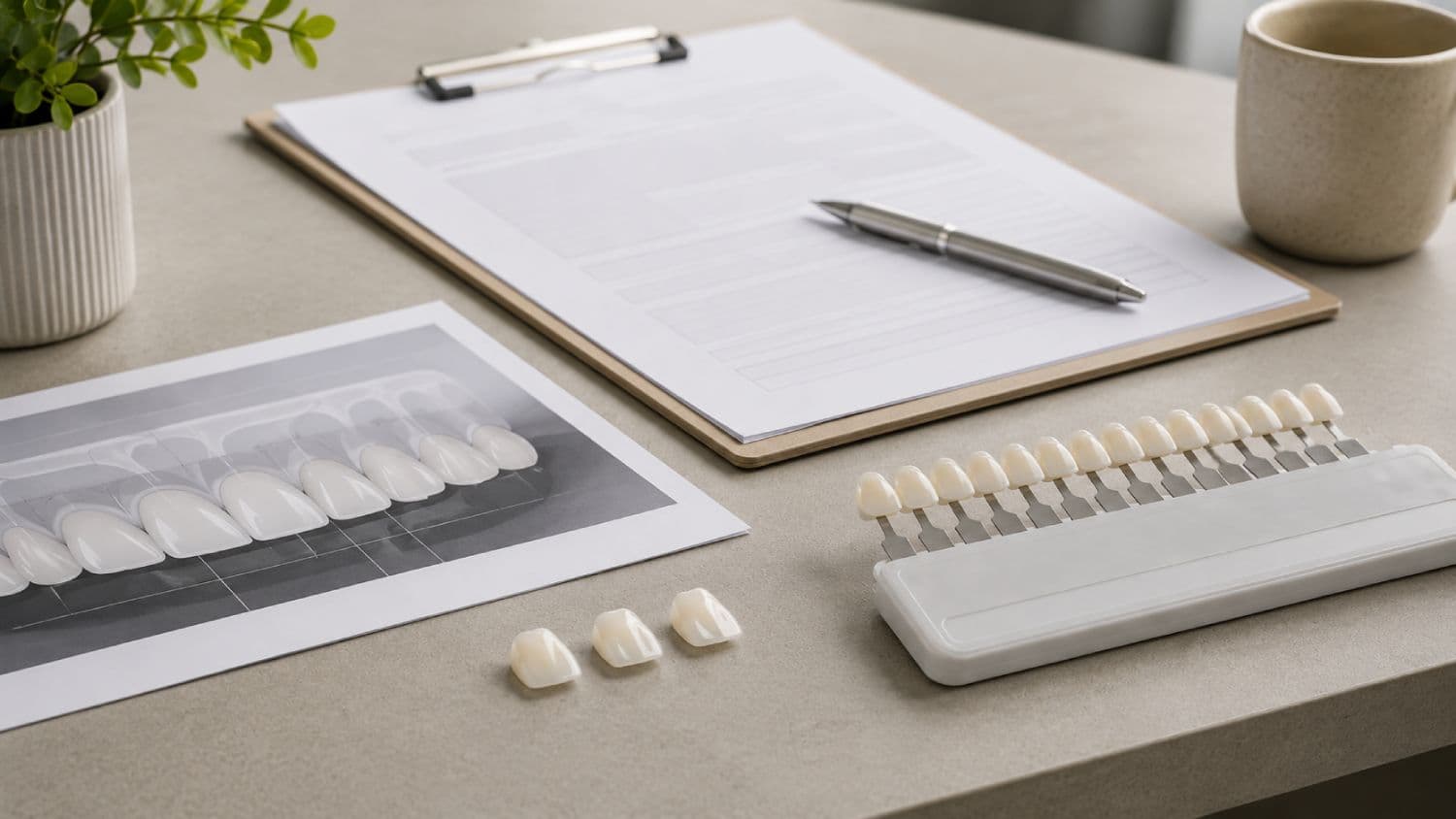
Where appropriate, planning may include photographs, scans or impressions, radiographs, a wax-up, digital design, mock-up, or temporary preview.
A digital simulation is a communication tool, not a guarantee. Final color, shape, gum response, facial appearance, and function may differ from a screen image.
What Happens After You Return Home?
Ask for copies of:
- the final treatment plan;
- material and laboratory information;
- pre-treatment and final radiographs;
- photographs or scans;
- medication records;
- written aftercare instructions;
- warranty terms;
- emergency contact details;
- a treatment summary for your local dentist.
Arrange routine dental care at home. A local dentist may be able to monitor gum health, tooth decay, margins, bite, and signs of grinding, although they are not automatically responsible for repairing treatment completed elsewhere.
Do not delay local assessment while waiting for a reply from an overseas clinic if you develop severe pain, swelling, fever, trauma, a loose restoration, difficulty eating, or another urgent concern.
For more location-specific planning, read the veneers cost in Istanbul guide.
Are Veneers in Turkey Worth It?
They may be financially attractive, but value cannot be judged from the headline price alone.
A good decision considers:
- whether veneers are clinically appropriate;
- how much healthy tooth structure will be removed;
- the dentist’s diagnosis and preparation plan;
- material and laboratory quality;
- communication and informed consent;
- time allowed for trial and adjustment;
- follow-up access;
- repair and replacement costs;
- the financial consequences of another trip.
The lowest initial quote can become expensive if additional procedures, premature replacement, or international travel are later required. A higher quote is not automatically better either. The treatment plan and clinical reasoning matter more than the marketing category.
Use the contact page to request a case-specific discussion of suitability, alternatives, timing, and aftercare.
Conclusion
Veneer cost in Turkey should be assessed together with diagnosis, tooth preparation, material choice, laboratory quality, informed consent, and long-term follow-up.
Before comparing packages, confirm which restoration is proposed, how much tooth structure will be removed, who will perform the work, what is included, and how problems will be handled after you return home.
Veneers can be a reliable treatment in selected patients, especially when planning is conservative and bonding is mainly to enamel. They are nevertheless irreversible in many cases and may require repair or replacement during a patient’s lifetime.
Choose a treatment plan because it is appropriate for your teeth—not simply because the package is inexpensive, fast, or visually dramatic.
Frequently Asked Questions
References
- European Central Bank: Euro foreign exchange reference rates
- Journal of Prosthodontic Research: Long-term survival and complications of laminate veneers
- Journal of Dentistry: Influence of tooth substrate on ceramic veneer survival
- Journal of Dentistry: Ten-year survival of porcelain laminate veneers
- Cleveland Clinic: Dental Veneers
- General Dental Council: Going abroad for dental treatment
- Republic of Türkiye Ministry of Health: Authorized healthcare providers for international health tourism