All-on-4 Dental Implants in Turkey: Cost, Stages and Safety
Medically reviewed by Dr. Furkan Küçük · Last reviewed:
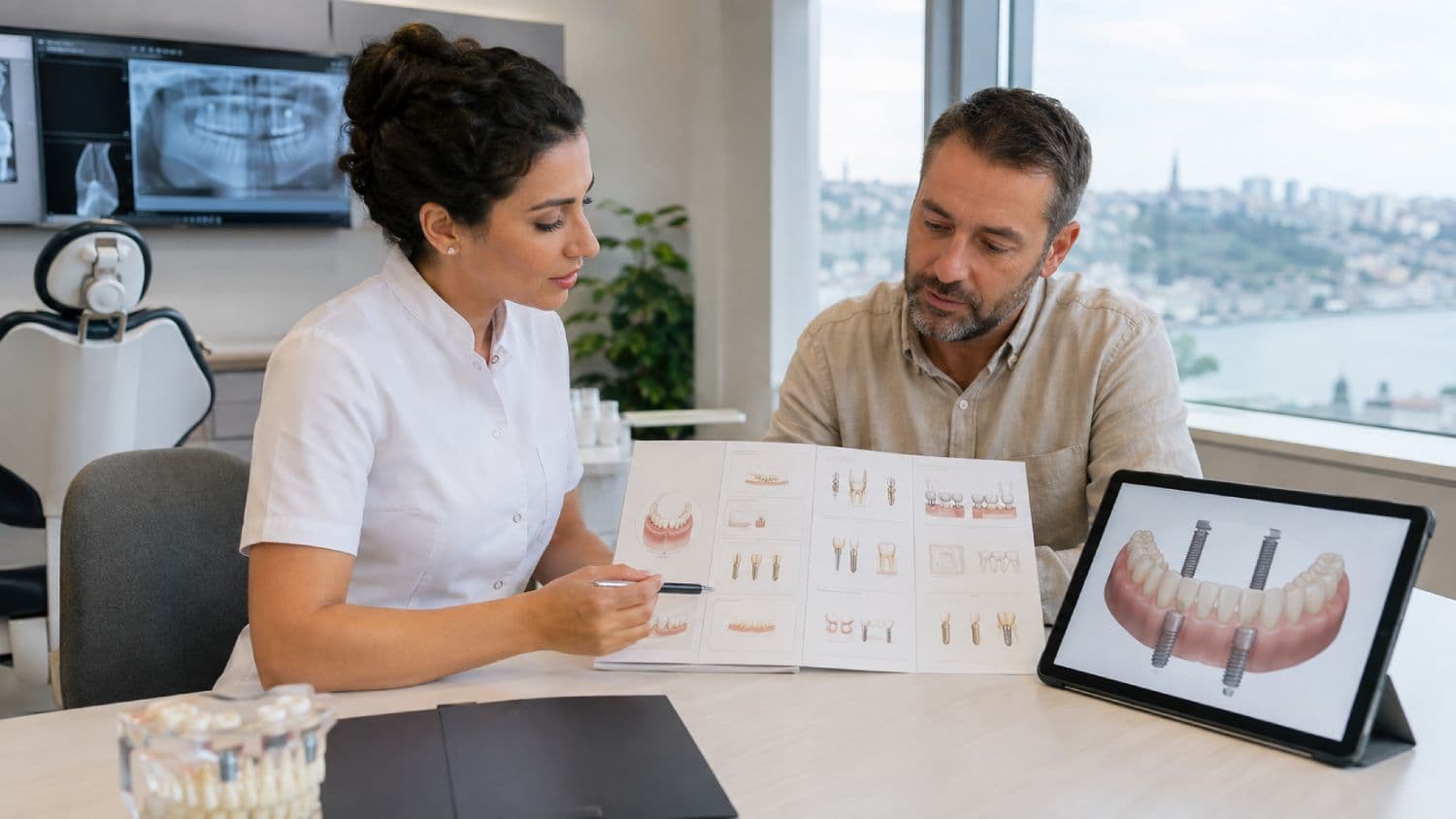
Exact All-on-4 Fixture Prices at Dr. Furkan Küçük Clinic
At Dr. Furkan Küçük Clinic in Istanbul, the controlled price for one dental implant fixture is:
- Turkish implant system: 225 euros per fixture
- German implant system: 300 euros per fixture
- Swiss implant system: 500 euros per fixture
Because an All-on-4 plan uses four implant fixtures for one jaw, the fixture-only calculation is:
- Turkish implant system: 900 euros for four fixtures
- German implant system: 1,200 euros for four fixtures
- Swiss implant system: 2,000 euros for four fixtures
For upper and lower jaws together, the fixture-only calculation is:
- Turkish implant system: 1,800 euros for eight fixtures
- German implant system: 2,400 euros for eight fixtures
- Swiss implant system: 4,000 euros for eight fixtures
These figures provide a transparent starting point. They are not complete All-on-4 treatment prices.
A complete quotation must also identify the multi-unit abutments, temporary teeth, final full-arch bridge, imaging, extractions, laboratory stages, anesthesia or sedation, possible bone grafting or sinus treatment, medicines, follow-up, maintenance and travel services.
Dental implant fixtures, abutments, fixation screws and the visible prosthetic teeth are separate parts of an implant-supported restoration.
Across Turkey, complete single-jaw All-on-4 packages are commonly discussed within a broad range of approximately 3,000 to 5,000 euros. This general range is meaningful only when the quotations include the same implant system, temporary bridge, final bridge material, number of visits, diagnostic procedures, additional treatments, and aftercare.
A low headline price may apply only to surgery and implant fixtures, while another quotation may cover most of the restorative process.
Hotel accommodation can be added from 55 euros per night through the clinic’s partner arrangements. Transfers and other travel services should be treated as included only when they appear in the current written quotation.
What All-on-4 Treatment Actually Means
All-on-4 is a full-arch implant treatment concept. It is designed for a jaw with no teeth or for a jaw in which the remaining teeth have been assessed as non-restorable.
Four appropriately distributed implants support one fixed bridge that replaces the teeth across that arch.
The front implants are usually placed more vertically. The posterior implants may be tilted to use the available bone more effectively, improve the front-to-back distribution of support and reduce interference with important anatomical structures.
Tilted implants are not a shortcut or proof that bone grafting will never be required. Their position, angle, length, and diameter must align with the patient’s anatomy and the planned prosthesis.
Clinical evidence indicates that intentionally tilted implants can perform similarly to vertically positioned implants when they are used appropriately in full-arch restorations.
The implant fixtures are only the foundation. Multi-unit abutments connect the implants to the bridge and help compensate for implant angulation.
A provisional bridge may be fitted during the early healing period, once the implants have achieved sufficient primary stability. After healing and reassessment, a final bridge is produced and adjusted to the patient’s bite, appearance, speech, hygiene access and facial proportions.
Four implants are commonly considered the minimum for a one-piece fixed full-arch prosthesis when they are appropriately distributed. This does not mean that every full-arch case should receive exactly four implants.
The number of implants should reflect:
- Bone volume
- Arch form
- Restorative space
- Bite forces
- The condition of the opposing teeth
- Hygiene requirements
- Patient preferences
- The consequences if one implant later develops a complication Results can vary according to anatomy, oral health, healing, treatment design, maintenance and other individual factors.
Who May Be Suitable for All-on-4?
All-on-4 may be considered for people who have lost all their teeth in one jaw, struggle with a removable denture, or have widespread dental disease that has left their remaining teeth with a poor prognosis.
Suitability cannot be confirmed from age, photographs or a panoramic X-ray alone.
The assessment should answer several important questions:
- Are any remaining teeth predictably restorable?
- Is there sufficient bone in the appropriate positions for stable implant placement?
- Are the gums and mouth free from uncontrolled active infection?
- Is there sufficient restorative space for a strong and cleanable bridge?
- Can the patient maintain hygiene beneath a fixed full-arch prosthesis?
- Could smoking, diabetes, medicines or other medical conditions affect healing?
- Is the bite affected by grinding, clenching or unusually high forces?
- Can the patient attend surgical, restorative and long-term maintenance visits?
A patient should not lose restorable teeth merely because a package is easier to advertise.
When teeth remain, preservation, periodontal treatment, conventional implants, removable options, and other restorative plans should be considered as part of informed consent.
Some people need medical stabilization, gum treatment, smoking cessation, extraction healing or bone treatment before implant placement.
Others may be better served by more than four implants, a removable implant-supported prosthesis, a staged approach or a non-implant alternative.
Overall health influences candidacy and healing. Smoking may delay healing and reduce long-term implant success. Uncontrolled diabetes, untreated gum disease, poor hygiene and heavy bite forces can also increase the risk of complications.
Examination, Imaging and Prosthetic Planning
A remote assessment can help the clinic understand your concerns, estimate the likely scope of treatment, and prepare a provisional quotation. It cannot replace an in-person examination.
Useful records for the first review include:
- Clear dental photographs
- A recent panoramic X-ray or cone-beam CT scan when available
- A list of medical conditions and medicines
- Smoking history
- Details of previous implants
- Information about existing dentures
- A description of your functional and aesthetic goals
Existing dentures can provide useful information about the bite, tooth position, facial support, speech, and what the patient does or does not like.
The final treatment plan requires a clinical examination and appropriate imaging.
The dental team assesses:
- The jawbone
- The gums
- The remaining teeth
- The smile line
- Lip and facial support
- The bite
- Nerve position
- Sinus anatomy
- Restorative space
- The proposed bridge design
The implant positions should be planned from the intended final teeth backward rather than placing the implants first and trying to make a bridge fit afterward.
The number, size and distribution of the implants must follow the prosthetic plan, arch form and available bone.
The written treatment plan should state whether it covers the upper jaw, lower jaw or both jaws.
It should identify:
- The planned number and system of implants
- Whether teeth will be extracted
- Whether immediate loading is intended
- What happens if primary stability is insufficient
- The temporary bridge material
- The final bridge construction
- The expected visits and healing interval
- Every provisional or excluded cost
The Stages of All-on-4 Treatment in Turkey
Remote Pre-Assessment
Before traveling, the clinic reviews the records you provide and prepares a preliminary treatment plan.
This is the appropriate time to clarify:
- The likely treatment
- The provisional quotation
- The expected number of visits
- Required medical information
- The temporary teeth
- The final bridge
- Travel services
- The payment schedule
- Aftercare arrangements
The remote plan remains provisional.
Imaging quality, active infection, hidden fractures, gum disease, bone defects, bite problems, or the prognosis of the remaining teeth may change the treatment after an in-person examination.
In-Person Examination and Confirmation
After arriving in Turkey, the dentist confirms your medical and dental history, examines your mouth and reviews or takes the necessary imaging.
Photographs, scans, impressions, bite records and facial measurements may be collected for prosthetic planning.
Treatment should not begin until you understand:
- The confirmed treatment plan
- Alternative treatment options
- The proposed materials
- The main risks
- The expected visits
- The treatment exclusions
- The consequences of changing from four implants to another number
Surgery and Implant Placement
If teeth are beyond repair, they may be extracted during the surgical stage.
The surgical team prepares the implant sites and places the planned fixtures in accordance with the patient’s anatomy and the restorative design.
Multi-unit abutments may then be connected to create a suitable platform for the temporary and final bridges.
Local anesthesia is commonly used. Sedation or general anesthesia is a separate decision based on the patient, the procedure, the provider, and the clinical setting.
The quotation should specify what type of anesthesia is planned and whether it is included.
Primary implant stability is measured during surgery. It is one of the essential requirements for immediate loading, though not the only consideration.
The loading decision may also depend on:
- Bone quality
- Implant distribution
- The rigidity of the temporary bridge
- Bite control
- Medical risk
- Simultaneous bone augmentation
- The patient’s ability to follow postoperative instructions
Temporary Fixed Teeth
When the implants and the overall case meet the loading criteria, a rigid temporary fixed bridge may be connected on the day of surgery or shortly afterward.
This can allow the patient to leave with fixed provisional teeth rather than a removable denture.
The word “temporary” is important.
The provisional bridge supports the treatment during healing and allows the dentist and patient to evaluate:
- Appearance
- Speech
- Comfort
- Tooth position
- Bite
- Hygiene access
The temporary bridge is not automatically made from the same material or designed in the same way as the final bridge.
Temporary bridges may require adjustments or repairs.
Recognized temporary prosthetic complications include:
- Fracture of the provisional bridge
- Screw loosening
- Chipping
- Damage to the veneering material
- Changes in the bite
If the implants do not achieve sufficient stability, the safest approach may be delayed loading or another temporary solution.
A clinic should explain this possibility before surgery rather than presenting same-day fixed teeth as an unconditional guarantee.
Healing and Osseointegration
The connection between the implant and the surrounding bone develops over time.
A common healing interval is approximately three to six months, although the actual period depends on:
- The treated jaw
- Bone quality
- Additional procedures
- General health
- The individual healing response
- The loading protocol
During this period, the temporary bridge should not be treated like natural teeth with unlimited chewing force.
Patients are commonly instructed to:
- Follow a modified or soft-food diet.
- Keep the bridge and gums clean.
- Avoid smoking
- Take prescribed medicines correctly.
- Attend scheduled reviews
Increasing pain, returning swelling, a loose bridge, an altered bite, a bad taste, persistent bleeding or movement should be reported promptly.
Final Bridge Stage
After healing, the dentist reassesses the implants, gums, hygiene, bite and provisional bridge design.
New scans or impressions may be taken for the final bridge.
The final prosthesis should be selected according to:
- Strength
- Repairability
- Appearance
- Weight
- Bite
- Hygiene access
- Cost
Possible constructions include acrylic or composite teeth on a framework, metal-ceramic designs or zirconia-based options.
“Zirconia” alone does not describe the entire prosthesis.
The quotation should specify:
- The framework material
- The veneering material
- The number of teeth
- The laboratory stages
- The repair policy
- The remake policy
The final bridge may require several try-ins and adjustments.
The patient should receive instructions for cleaning, maintenance, night protection when indicated, and what to do if a screw, tooth, or bridge component becomes loose or damaged.
Can All-on-4 Provide Same-Day Teeth?
All-on-4 is commonly associated with immediate fixed temporary teeth, but immediate loading is a clinical protocol rather than a guaranteed package feature.
A fixed provisional bridge may be possible when:
- The implants achieve adequate primary stability.
- Implant distribution is suitable.
- A sufficiently rigid temporary bridge can be produced.
- The bite can be controlled.
- The patient can follow postoperative restrictions.
- Additional procedures do not make immediate loading unsuitable.
Immediate loading may be less appropriate when:
- Implant stability is insufficient.
- Major bone augmentation is needed.
- Sinus treatment is required.
- Infection is uncontrolled
- Medical risk is too high.
- The prosthetic design cannot be delivered safely.
The need for simultaneous bone augmentation or sinus-floor treatment may make immediate loading less predictable.
A responsible quotation explains both possible pathways: the intended immediate-loading option and the alternative if the surgical findings do not support it.
The objective is not to force treatment into a promised timetable. It is to protect healing and create a maintainable final result.
Does All-on-4 Always Avoid Bone Grafting?
No.
Tilting the posterior implants can sometimes use the available bone more efficiently and reduce the need for extensive grafting. It cannot remove every anatomical limitation.
Some patients may still require:
- Local bone grafting
- Sinus-related treatment
- Ridge modification
- Staged healing
- Alternative implant positions
- A different number of implants
- A removable implant-supported prosthesis
- A conventional staged implant approach
The need for grafting should be based on the clinical examination, three-dimensional imaging when indicated, prosthetic requirements, and the surgeon’s assessment.
“Graft-free” should not be treated as a guaranteed package feature.
Tilted implants are a useful clinical option, but patient selection and anatomy remain decisive.
What Changes the Total All-on-4 Cost?
The Implant System
Four Turkish, German, or Swiss implant fixtures create different starting subtotals.
Ask for the manufacturer and exact implant model, not only the country label. Keep this information with your treatment records.
The Abutments and Restorative Components
Multi-unit abutments, prosthetic screws, cylinders and related components are essential parts of the restoration.
They may be original manufacturer components or compatible components.
The quotation should identify the proposed system and state exactly what is included.
The Temporary Bridge
Confirm:
- Whether a fixed provisional bridge is included
- When it will be fitted
- Which material will be used?
- How many adjustments are covered
- What happens if immediate loading is not possible
The Final Bridge
The final bridge material and construction are major cost variables.
The quotation should describe the complete design rather than using only a general term such as “zirconia” or “porcelain.”
Ask whether the price includes:
- Digital or physical impressions
- Design stages
- The framework
- The prosthetic teeth
- Try-ins
- Bite adjustments
- Final delivery
- Repairs
- Remakes
- Written material specifications
Extractions and Infection Management
The number and difficulty of extractions, the removal of retained roots, and the treatment of infected sites can change the surgical scope.
Bone and Sinus Procedures
Local bone grafting, ridge modification, sinus treatment, membranes and biomaterials should be itemized.
They should not appear as unexplained charges after travel when their possible need was reasonably visible in the available records.
Diagnostics and Guided Planning
Ask whether the following are included:
- Panoramic imaging
- Cone-beam CT scanning
- Digital scans
- Surgical guides
- Laboratory planning
- Medical tests
Anesthesia, Sedation and Medicines
The quotation should distinguish local anesthesia from sedation or general anesthesia.
It should also identify prescribed medicines and whether their cost is included.
Travel and Accommodation
Hotel accommodation may be added from 55 euros per night.
Confirm:
- The expected number of nights
- The room type
- Companion costs
- Airport transfers
- Hotel-to-clinic transfers
- What happens if treatment requires an extended stay
Follow-Up and Maintenance
A low surgical price can become expensive when adjustments, repairs, hygiene appointments, or complication management are excluded.
Ask what the clinic provides after you return home and what you must arrange with a local dentist.
All-on-4 Versus All-on-6
All-on-4 and All-on-6 are both methods of supporting a fixed full-arch prosthesis.
The difference is not simply that six implants are “premium” and four implants are “budget.”
Four appropriately distributed implants can support a one-piece full-arch bridge in suitable cases.
Six implants may provide additional distribution, permit different prosthetic segmentation, or offer more flexibility if one implant later develops a problem.
However, six implants require suitable bone and positions, increase the number of surgical sites and components, and do not necessarily yield better results.
Available clinical evidence indicates broadly similar survival and complication outcomes between All-on-4 and All-on-6 treatments. However, the quality and design of the available studies vary, so the choice should still be individualized.
Ask the dentist to explain:
- Why the recommended number is appropriate for your jaw
- How the bridge will be supported
- How hygiene access will be maintained
- Whether the prosthesis will be one piece or segmented
- What would happen if one implant failed in the future?
Risks and Complications to Understand
All-on-4 treatment can restore fixed teeth and chewing function, but it combines surgery, implants, abutments, screws, and a large prosthesis. Each part can experience complications.
Early surgical or healing risks include:
- Pain
- Swelling
- Bruising
- Bleeding
- Infection
- Delayed healing
- Failure of osseointegration
- Injury to nearby teeth or tissues
- Altered sensation
- Nerve injury
- Sinus complications
- Jawbone injury
- A change in the treatment plan during surgery
Later biological risks include:
- Inflammation around the implants
- Peri-implant mucositis
- Peri-implantitis
- Bone loss
- Gum recession
- Hygiene difficulty
- Implant loosening
- Implant loss
Prosthetic and mechanical complications may include:
- Loose screws
- A fractured temporary bridge
- Chipped or worn teeth
- Damaged veneering material
- An altered bite
- Framework damage
- Repair or replacement of bridge components
Smoking, uncontrolled diabetes, local infection, untreated gum disease, delayed healing, and difficulty cleaning around the implants can increase the risk of failure or complications.
Implant survival statistics do not mean that every bridge remains complication-free.
A proper consent discussion distinguishes between:
- Implant survival
- Prosthesis survival
- Repair requirements
- Biological health
- Comfort
- Appearance
- Patient satisfaction
Planning Dental Travel to Turkey
International treatment adds travel decisions to an already complex dental plan.
Before booking flights, verify:
- The treating clinician
- The clinical facility
- The written treatment scope
- The quotation
- Follow-up arrangements
- Urgent-care procedures
Healthcare providers offering international health-tourism services in Turkey may be authorized by the Turkish Ministry of Health.
Authorization is a useful administrative check, but it does not replace the need to review the named dentist’s qualifications, the proposed treatment, the clinic’s communication, and the aftercare plan.
Allow sufficient time for:
- Examination
- Treatment
- Laboratory stages
- Clinical checks
- Possible bridge adjustments
Avoid planning an intensive sightseeing schedule immediately after surgery.
Long flights, swelling, prescribed medicines, dietary restrictions and unexpected clinical changes should be considered.
Before returning home, obtain copies of:
- Imaging and photographs
- The final treatment plan
- Consent documents
- The surgical report
- Implant manufacturer and model information
- Abutment and component details
- Prescriptions
- Temporary and final bridge records
- Maintenance instructions
- Contact information for urgent concerns
Ask who will answer urgent questions, who will provide local maintenance, and how costs will be handled if you require additional treatment after returning home.
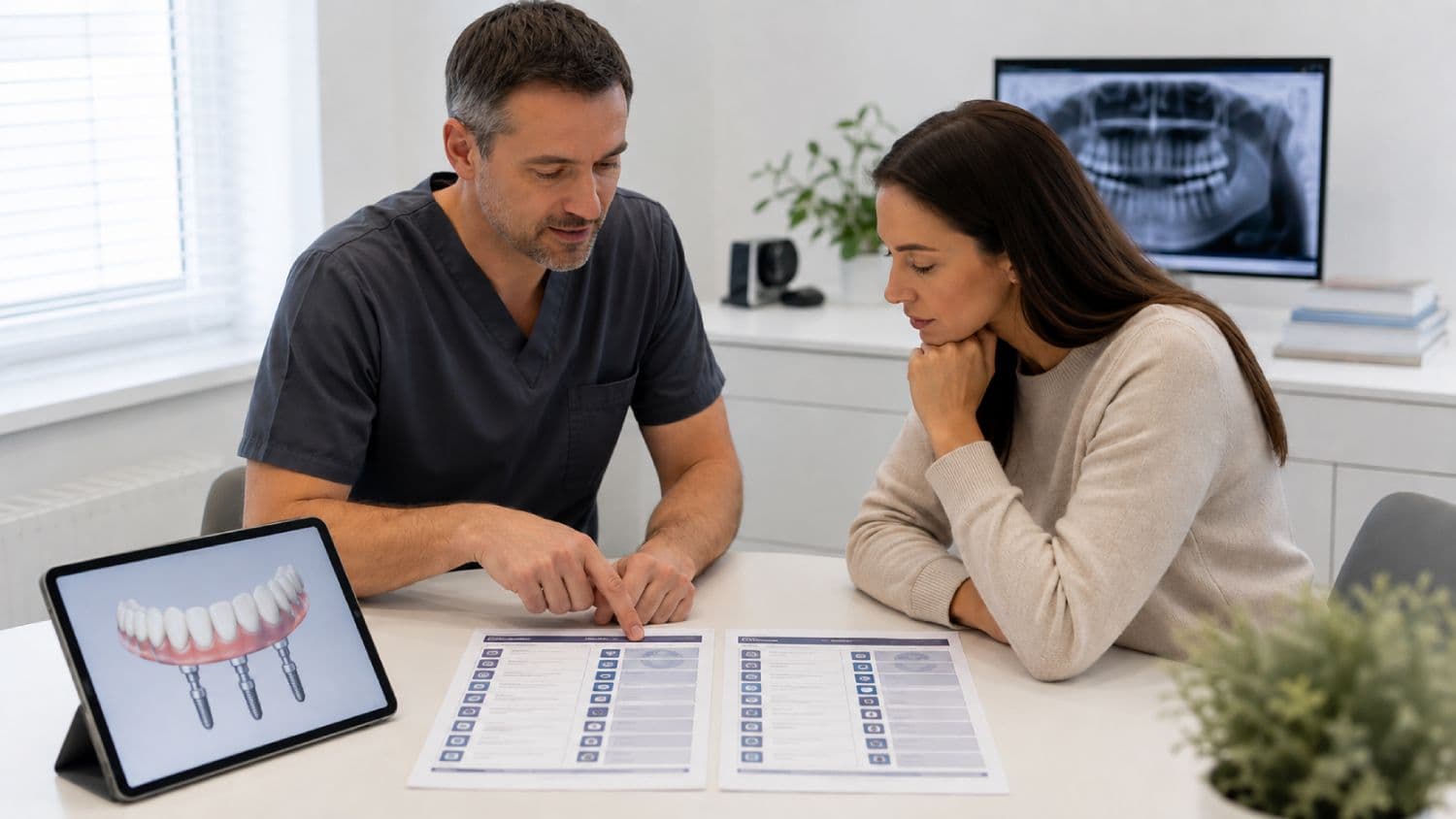
How to Compare Two All-on-4 Quotations Fairly
Compare the same treatment scope, not just the final number.
A useful written quotation should answer the following questions:
-
Is the price for one jaw or both jaws?
-
How many implants are planned in each jaw?
-
What implant manufacturer and model are proposed?
-
Are multi-unit abutments and prosthetic components included?
-
Are extractions and infection management included?
-
Is a fixed temporary bridge included?
-
What happens if immediate loading is not possible?
-
What is the exact final bridge construction?
-
Are imaging, scans, guides and laboratory stages included?
-
Are grafting or sinus procedures included, excluded, or provisional?
-
What anesthesia or sedation is planned?
-
How many visits and hotel nights are expected?
-
Which transfers and travel services are included?
-
How many adjustments and follow-up appointments are included?
-
What maintenance and local follow-up are required?
-
What are the repair, remake and warranty terms?
-
Which costs can change after examination?
-
What is the cancellation and payment schedule?
A transparent quotation can still change when the examination reveals new clinical information.
The difference is that the possible changes and decision rules are explained before treatment.
Cleaning, Maintenance and Long-Term Costs
All-on-4 bridges are fixed but not maintenance-free.
Plaque can collect around the implant connections and beneath the bridge. The prosthesis must provide sufficient access for cleaning.
Daily care may include:
- A soft toothbrush
- Interdental brushes
- Floss designed for bridges
- An oral irrigator
- Other tools recommended for the specific bridge design
Professional maintenance intervals should be individualized.
Many implant patients are reviewed every three to six months, especially when they have:
- A history of gum disease
- A smoking habit
- Difficult hygiene access
- Previous implant complications
- Heavy bite forces
Maintenance appointments may include:
- Examination of the gums and implants
- Professional cleaning
- Bite assessment
- X-rays when indicated
- Screw and bridge checks
- Reinforcement of home-care techniques
Long-term implant success depends heavily on careful cleaning and regular professional follow-up.
Bridge teeth and restorative materials may also wear, chip, stain, or fracture and may eventually require repair or replacement.
Maintenance costs, night guards, professional cleaning, screw replacement, repairs, and eventual prosthesis replacement should be included in the long-term budget.
Conclusion
All-on-4 dental implants in Turkey can be a practical fixed full-arch option when treatment is planned around the patient rather than around a package.
At Dr. Furkan Küçük Clinic, four implant fixtures create a clear starting subtotal of:
- 900 euros for Turkish implant fixtures
- 1,200 euros for German implant fixtures
- 2,000 euros for Swiss implant fixtures
The complete quotation must then account for the abutments, temporary teeth, final bridge, diagnostics, surgery, possible additional procedures, travel services, follow-up and maintenance.
The strongest treatment plan is not automatically the cheapest, the fastest or the one containing the most implants.
It is the plan that preserves treatable teeth where appropriate, explains why four implants are suitable, includes a safe alternative when immediate loading is not possible, identifies every major cost and provides realistic long-term care.
Frequently Asked Questions
References
- Dr Furkan Küçük Dental Clinic: Dental implant prices in Turkey
- Dr Furkan Küçük Dental Clinic: All-on-4 dental implants in Istanbul
- ITI: Number of implants for complete-arch fixed prostheses
- ITI: Loading protocols for fixed prostheses in edentulous jaws
- ITI: Intentionally tilted versus axial implants
- FDA: Dental Implants - What You Should Know
- PubMed: All-on-4 versus All-on-6 systematic review
- Cambridge University Hospitals: Dental implants in restorative dentistry
- CDC Yellow Book: Medical Tourism
- Republic of Türkiye Ministry of Health: Authorized Healthcare Providers