Full Mouth Dental Implants in Turkey: Price Guide
Medically reviewed by Dr. Furkan Küçük · Last reviewed:
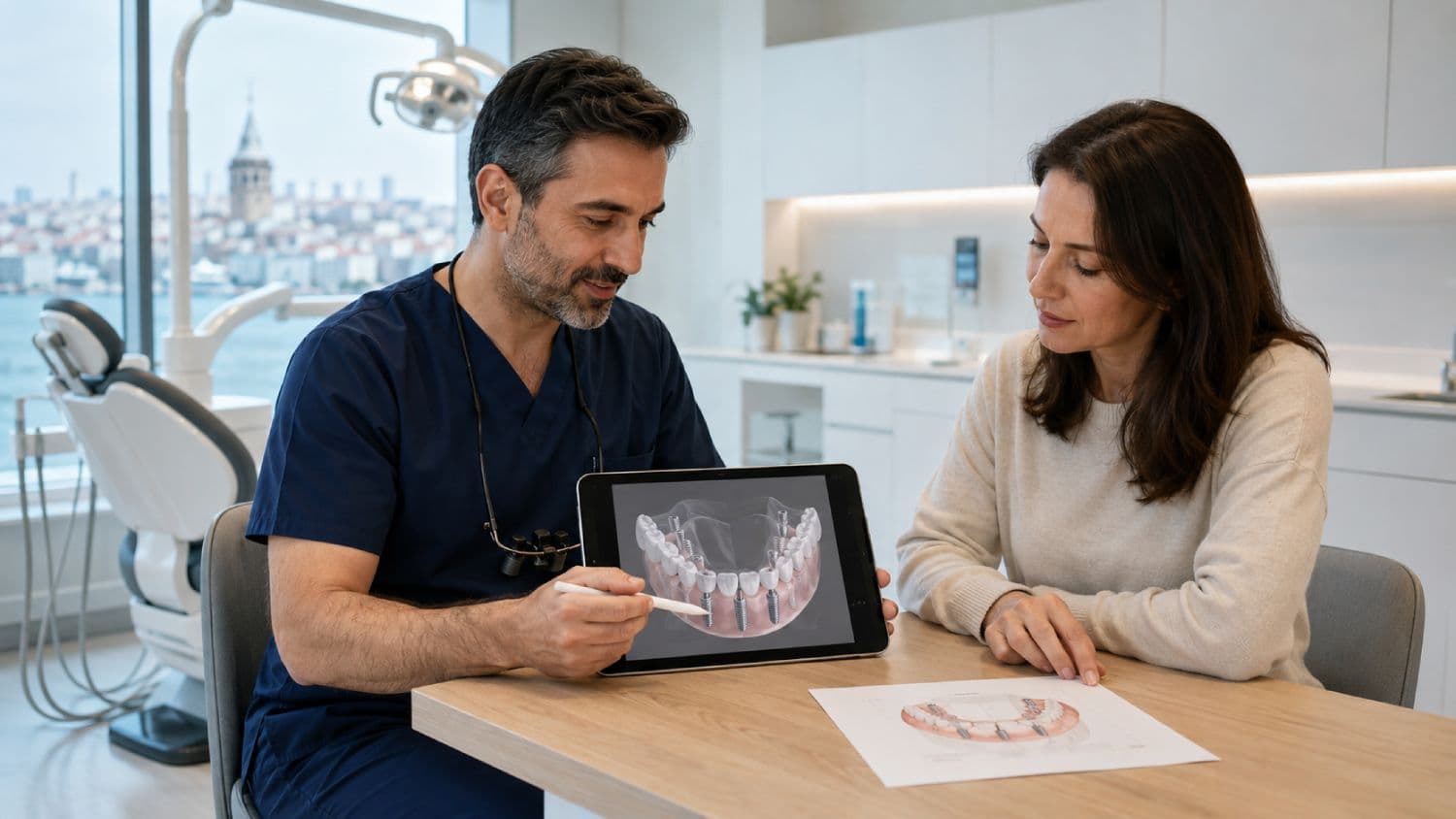
Full Mouth Dental Implants in Turkey: Our Prices and Planning Guide
The price of full-mouth dental implants in Turkey cannot be reduced to one standard package figure. “Full mouth” may mean replacing the teeth in one jaw or both jaws. It may describe a fixed full-arch bridge, a removable implant-supported overdenture, an All-on-4 or All-on-6 treatment concept, or a personalized plan that preserves some natural teeth.
At Dr Furkan Küçük Dental Clinic, we begin with transparent base prices rather than a vague promotional total. Your final quotation is then prepared according to your examination, the selected implant system, the number of implants, the condition of your remaining teeth, the provisional restoration, the definitive teeth, and any additional treatment that may be required.
The prices below are approximate English-display conversions of the clinic’s controlled base-price table. They are intended to explain the starting cost structure, not to guarantee a final treatment price.
Our Published Dental Implant Prices
Our treatment-cost calculator uses the clinic’s canonical base-price table. For the English article, those values are shown as approximate British pound and US dollar conversions.
Implant Fixtures
- Turkish implant system: approximately £191 / $257 per tooth
- German implant system: approximately £255 / $343 per tooth
- Swiss implant system: approximately £425 / $572 per tooth
Restorative Treatments
- Zirconia crown: approximately £119 / $160 per tooth
- E.max crown: approximately £145 / $194 per tooth
- Veneer: approximately £170 / $229 per tooth
Optional Accommodation Estimate
- Hotel accommodation: approximately £47 / $63 per night
These are approximate conversions of the clinic’s base prices before discounts and special offers. The conversions use the European Central Bank reference-rate snapshot dated 17 July 2026. Exchange-rate movements or payment-provider charges may change the amount paid.
Final pricing depends on the individual treatment plan. Review the current offers and contact the clinic for a personalized written quotation; no discount or package should be assumed until it is confirmed for your plan.
A complete full-mouth quotation may also need to account for abutments, connecting components, provisional teeth, the definitive bridge or denture, laboratory work, extractions, imaging, bone grafting, sinus procedures, sedation, prescribed medicines, and follow-up appointments.
The calculator below can help you build an initial estimate from available treatment and accommodation items. It cannot diagnose your condition or replace a personalized examination and final written treatment plan.
Example Implant-Fixture Baselines for Both Jaws
The examples below show how the controlled implant prices can be used to estimate the implant-fixture subtotal for both jaws. They cover implant fixtures only and do not represent the full price of treatment.
Eight-Implant Concept
A treatment plan that places four implants in the upper jaw and four in the lower jaw involves eight implant fixtures.
- Eight Turkish implants: approximately £1,532 / $2,058
- Eight German implants: approximately £2,042 / $2,744
- Eight Swiss implants: approximately £3,404 / $4,574
Twelve-Implant Concept
A treatment plan that places six implants in each jaw involves twelve implant fixtures.
- Twelve Turkish implants: approximately £2,298 / $3,087
- Twelve German implants: approximately £3,064 / $4,117
- Twelve Swiss implants: approximately £5,106 / $6,861
The correct number of implants cannot be selected from price alone. It must be determined according to the proposed restoration, available bone, implant positions, bite forces, anatomy, and clinical findings.
Why the Implant Subtotal Is Not the Complete Treatment Price
Full-mouth implant treatment involves more than placing implant fixtures. The complete treatment usually includes three connected elements:
- The surgical foundation, including the implants and any necessary preparatory treatment
- The provisional teeth used during healing, when appropriate
- The definitive bridge or denture fitted after the required clinical and laboratory stages
A low implant-fixture subtotal may exclude important parts of treatment, such as the provisional restoration, abutments, final bridge, laboratory work, or additional procedures.
Your written quotation should therefore identify the complete proposed treatment rather than listing only the cost of the implants.
What Does “Full-Mouth Dental Implants” Mean?
The term can describe several different treatments:
- A fixed full-arch bridge in the upper jaw
- A fixed full-arch bridge in the lower jaw
- Fixed full-arch bridges in both jaws
- A removable implant-supported overdenture
- A combination of fixed and removable restorations
- A plan that preserves selected natural teeth
A fixed full-arch bridge remains in the mouth during normal daily use. A dentist may still need to remove it professionally for maintenance or repair.
An implant-supported overdenture is removable. The implants improve its stability or support, but the patient removes it for cleaning.
A conventional complete denture does not use implants. It may remain a suitable alternative for someone who does not want implant surgery, is not clinically suitable for it, or prefers a lower initial cost.
These treatments have different surgical requirements, prices, cleaning needs, maintenance schedules, and repair considerations. Your quotation should name the exact restoration proposed for each jaw. The broader dental implant planning guide explains candidacy, alternatives, treatment stages, and records in more detail.
Examples of completed treatment can illustrate different approaches, but they cannot predict your healing, appearance, function, or longevity. Individual results may vary.
Does “Full Mouth” Mean One Jaw or Both Jaws?
Not always. Some providers use “full mouth” for one complete arch, while others use it for both the upper and lower jaws.
Your quotation should state clearly whether it covers the upper jaw, lower jaw, or both. The two jaws do not necessarily require the same treatment. One may be suitable for a fixed bridge while the other is better managed with an overdenture, conventional denture, or preservation of selected teeth.
Do All Remaining Teeth Need to Be Extracted?
Not necessarily.
Before accepting a full-arch implant plan, ask for an individual assessment of the remaining teeth. It should explain which teeth are healthy, which may be restored, which have a guarded prognosis, which are considered non-maintainable, and why each extraction is proposed.
Removing a maintainable tooth is irreversible. Depending on your condition, alternatives may include periodontal treatment, restorative dentistry, preserving selected teeth, combining natural teeth and implants, using a removable denture, or postponing treatment.
The decision should take into account your dental health, medical history, gum condition, available bone, bite, healing capacity, and ability to maintain the final restoration.
What Changes the Final Full-Mouth Implant Price?
The Number of Jaws Being Treated
Treating both jaws generally requires more implants, more extensive laboratory work, and more complex bite planning than treating one arch.
The Number of Implants
Four, six, or another number of implants may be proposed for each jaw. More implants increase the fixture subtotal, but more are not automatically better, and fewer are not automatically the most appropriate or economical choice.
The implant number and distribution should follow the complete surgical and restorative plan.
The Selected Implant System
The approximate converted implant base prices are:
- £191 / $257 for a Turkish implant system
- £255 / $343 for a German implant system
- £425 / $572 for a Swiss implant system
The selected manufacturer and system should be identified in your written plan. A higher-priced system does not replace the need for accurate diagnosis, correct positioning, appropriate restorative design, good hygiene access, and long-term maintenance.
The Condition of the Remaining Teeth
Active decay, periodontal disease, infection, failing restorations, or an unstable bite may need to be treated before implant placement. Any proposed extraction should be listed and explained individually.
Bone Volume and Anatomy
Implants need to be positioned within suitable bone while avoiding important structures such as nerves and sinuses.
Depending on the findings, treatment may involve bone grafting, ridge augmentation, sinus augmentation, alternative implant positions, a removable implant-supported restoration, or a non-implant alternative. These procedures can change the number of appointments, healing period, and final price.
The Provisional Teeth
A treatment plan may provide a removable temporary denture, a fixed provisional bridge, modification of an existing denture, or no immediate replacement in a particular area.
The provisional restoration is normally different from the definitive bridge. Its material, purpose, and expected period of use should be stated in the quotation.
The Definitive Bridge or Denture
The final restoration may vary according to whether it is fixed or removable, its framework and visible materials, number of replacement teeth, restorative space, bite forces, opposing teeth, hygiene access, repairability, and laboratory technique.
The approximate converted base prices are £119 / $160 per tooth for a zirconia crown and £145 / $194 per tooth for an E.max crown. A full-arch bridge is a customized restoration and should not automatically be calculated as a simple number of individual crowns.
Your quotation should identify the proposed final restoration and explain how its price has been calculated.
Imaging, Surgical Planning, and Anesthesia
Confirm whether the quotation includes panoramic radiographs, three-dimensional imaging when required, surgical planning, surgical guides where indicated, local anesthesia, any proposed sedation, prescribed medicines, and postoperative reviews.
Sedation should not be assumed to be included simply because implant surgery is included.
Laboratory Work and Try-Ins
A full-arch restoration may require digital scans or conventional impressions, bite records, trial restorations, aesthetic checks, speech assessment, bite adjustments, and final laboratory modifications.
Ask how many laboratory stages and try-ins are included and what happens if further changes are required.
All-on-4 or All-on-6?
All-on-4 and All-on-6 are treatment concepts, not universal prescriptions.
All-on-4 uses four implants to support a full-arch restoration. Angled posterior implants may be considered in selected cases, but the concept does not guarantee that grafting will be avoided or that fixed provisional teeth can be provided immediately.
All-on-6 uses six implants. The additional implants may change the distribution of support, but six are not automatically better for every patient.
The decision should consider available bone, arch shape, implant positions, remaining teeth, bite forces, the opposing jaw, hygiene access, the proposed bridge, and the consequences if an implant later develops a problem.
For both jaws, the approximate implant-fixture range is £1,532 / $2,058 to £3,404 / $4,574 for eight implants and £2,298 / $3,087 to £5,106 / $6,861 for twelve implants, depending on the selected system.
The definitive price must also include the restorative and clinical elements of the plan.
Can Fixed Teeth Be Fitted on the Day of Surgery?
Some selected patients may receive a fixed provisional restoration shortly after implant placement.
This depends on primary implant stability, bone condition, implant distribution, the proposed bridge design, bite forces, the need for grafting, oral health, and general health.
“Same-day teeth” should not be confused with the definitive bridge. The early restoration is usually provisional and may require restricted loading, a modified diet, later adjustment, and replacement after healing.
Fixed provisional teeth should not be guaranteed before the clinical examination and implant-placement procedure.
How Many Visits to Turkey Are Required?
There is no single schedule that applies to every patient. A full-mouth treatment sequence may include:
- Remote information gathering and an initial estimate
- An in-person examination and diagnosis
- Treatment of active dental or gum disease
- Extractions or grafting where required
- Implant placement
- A provisional restoration when appropriate
- A healing period and clinical review
- Scans or impressions for the final restoration
- Bite records and try-ins
- Fitting and adjustment of the definitive teeth
- Long-term maintenance
Some stages may be combined when clinically appropriate. Other cases may require separate visits. Before booking travel, ask for the purpose of each expected visit and the circumstances that could require another journey.
What Your Written Quotation Should Include
A useful full-mouth implant quotation should identify:
- Whether one jaw or both jaws are included
- The diagnosis and prognosis of the remaining teeth
- Which teeth are proposed for extraction and why
- Reasonable tooth-preserving and removable alternatives
- The restoration proposed for each jaw
- The number and planned distribution of implants
- The selected implant system
- Implant fixtures, abutments, screws, and connecting components
- Any proposed bone grafting or sinus procedure
- The type of provisional teeth
- The definitive bridge or denture design
- The restorative materials
- Imaging and surgical planning
- Anesthesia or sedation
- Laboratory work and try-ins
- Expected appointments and reviews
- Prescribed medicines and postoperative care
- Maintenance requirements
- Written warranty terms and exclusions
- Circumstances that could change the treatment or price
- Responsibility for complications and remedial treatment
- Any accommodation or transfer arrangements
An estimate prepared from photographs or existing scans can help with initial budgeting. It should remain provisional until the in-person examination and required diagnostic procedures have been completed.
Use Our Calculator Before Reviewing Offers
The treatment-cost calculator uses the clinic’s controlled base prices. A practical sequence is to select the potentially relevant treatments and quantities, review the estimate, add optional accommodation where appropriate, review any available offer separately, and then request a personalized assessment and written quotation.
The calculator is a budgeting tool. It does not replace a diagnosis or final treatment plan.
Build a Total-Care Budget
The clinic invoice is only one part of the financial decision. International patients may also need to budget for flights, accommodation, meals and local transport, a companion where needed, time away from work, travel insurance, treatment required before surgery, local dental care, professional implant maintenance, repairs, replacement components, emergency assessment, and another journey if in-person remedial care is required.
The optional hotel estimate is approximately £47 / $63 per night. The appropriate number of nights should follow the planned clinical appointments rather than a fixed package assumption.
Verifying the Clinic and Treatment Team
Before treatment, establish who performs the diagnosis, places the implants, carries out grafting or sinus procedures, designs the provisional restoration, designs and fits the definitive bridge, provides reviews and emergency support, and communicates with you after you return home.
Obtain the registered name and address of the treatment facility and confirm that the necessary administrative authorizations are current. Administrative authorization is an important verification step, but it does not replace individual diagnosis, informed consent, or a clear explanation of the proposed treatment.
Risks and Long-Term Maintenance
Dental implants can support replacement teeth, but complications can occur during healing or years later. Potential problems include infection, delayed healing, failure of an implant to integrate, injury to nearby tissues, sinus complications, altered sensation, difficulty cleaning, an uncomfortable bite, loosened screws, implant mobility, chipping or wear, fracture of a component, and the need for repair or replacement.
Smoking can adversely affect healing and long-term implant health.
Full-mouth implant treatment does not remove the need for daily cleaning and professional maintenance. Ask to see how you will clean beneath the proposed bridge before accepting the design.
Contact a dentist promptly if an implant or restoration becomes mobile, painful, or swollen; persistently bleeds; or causes a noticeable change in your bite. The dental implant aftercare guide explains maintenance and warning signs in more detail.
Records to Take Home
Before leaving Turkey, request the final treatment plan, consent documents, radiographs and scans, surgical and restorative notes, implant manufacturer and system, implant dimensions and positions, component details where available, graft or biomaterial records, laboratory and bridge information, prescriptions, postoperative instructions, maintenance guidance, emergency contacts, and written warranty terms.
Keeping accurate implant and component records can help another dentist identify compatible parts if maintenance or repair becomes necessary.
Price and Treatment Red Flags
Pause before paying when:
- “Full mouth” does not specify one jaw or both jaws
- The quotation lists implants but not the final teeth
- The proposed bridge or denture is not named
- Many teeth are scheduled for extraction without an individual prognosis
- Fixed teeth are guaranteed before examination
- A one-trip result or identical healing timetable is guaranteed
- All-on-4 or All-on-6 is recommended without explaining why
- An implant brand is presented as proof of success
- A “lifetime warranty” is offered without detailed written terms
- Grafting and additional procedures are not discussed
- Maintenance and repair costs are ignored
- Responsibility for complications is unclear
- You are pressured to pay immediately to retain a discount
Transparent pricing should become clearer when questions are asked. It should not depend on vague package wording or pressure to decide quickly.
Conclusion
The approximate converted implant base prices are:
- £191 / $257 for a Turkish implant system
- £255 / $343 for a German implant system
- £425 / $572 for a Swiss implant system
For both jaws, this creates approximate implant-fixture starting ranges of £1,532 / $2,058 to £3,404 / $4,574 for eight implants and £2,298 / $3,087 to £5,106 / $6,861 for twelve implants.
These figures are not the full price of full-mouth rehabilitation. The final cost depends on which teeth can be preserved, whether one or both jaws are treated, implant number and position, provisional teeth, the definitive bridge or denture, laboratory work, bone procedures, and required treatment stages.
Use the calculator to understand the starting estimate, then obtain a personalized examination and itemized written plan. The most useful comparison is between complete treatment plans that clearly explain what will be done, what is included, what may change, and how long-term care will be managed.
Frequently Asked Questions
References
- Dr Furkan Küçük Dental Clinic: Offers and treatment-cost calculator
- FDA: Dental Implants - What You Should Know
- Cambridge University Hospitals: Dental implants in restorative dentistry
- Cambridge University Hospitals: Bone grafting for dental implants
- Guy's and St Thomas' NHS Foundation Trust: Dental implants
- NHS: Dental treatments
- ITI: Loading protocols for fixed prostheses in edentulous jaws
- CDC Yellow Book 2026: Medical Tourism
- GOV.UK: Turkey travel advice - health
- Republic of Türkiye Ministry of Health: Authorized Healthcare Providers