Platelet-Rich Plasma Dental Treatment: Uses, Evidence, Safety and Cost
Medically reviewed by Dr. Furkan Küçük · Last reviewed:

Platelet-Rich Plasma Dental Treatment: Uses, Evidence, Safety and Cost
Platelet-rich plasma, usually shortened to PRP, is a preparation made from a small sample of your own blood. The blood is processed to obtain a platelet-enriched fraction, which may then be applied during another dental procedure.
PRP may be offered during a tooth extraction, bone grafting, periodontal treatment, or a dental implant procedure, or as part of a specialized regenerative treatment. It is an adjunct, not a stand-alone cure. It does not replace an accurate diagnosis, careful surgery, infection control, stable implant placement, appropriate graft material, periodontal treatment, or aftercare.
One of the most important details is often missed in patient-facing information: PRP is not the same as platelet-rich fibrin, or PRF. The products are prepared differently, and evidence about one cannot automatically be used to prove the benefits of the other.
PRP may have a useful role in selected cases. Still, it should not be sold as a guaranteed way to heal faster, avoid complications, improve implant survival, or shorten a treatment schedule. The expected benefit depends on the exact concentrate, preparation protocol, dental indication, medical history, and quality of the underlying treatment.
The Practical Answer Before the Details
PRP may be a reasonable optional addition in selected dental cases. Some studies report improvements in particular areas, such as early healing, comfort, or regenerative measures. Other studies find little or no clinically important difference.
The evidence is especially easy to overstate because many newer studies concern PRF, injectable PRF, plasma rich in growth factors, or mixed groups of autologous platelet concentrates rather than conventional PRP alone. Preparation methods, procedures, and outcome measurements vary considerably.
Before agreeing to PRP, ask five questions:
- What exact platelet concentrate are you proposing?
- What specific problem in my case is it intended to address?
- Is it optional, recommended, or essential to the planned procedure?
- What is the separate cost, and what may cost extra?
- What happens during healing, and who is responsible if complications occur?
A clear answer to those questions is more useful than a general promise that “growth factors” will make everything heal faster.
What Is Platelet-Rich Plasma?
Platelets are blood components involved in clotting and the early stages of wound healing. They release signaling molecules that participate in inflammation, blood-vessel formation, and tissue repair.
To prepare PRP, a small amount of venous blood is collected and placed in a centrifuge. Centrifugation separates the blood into fractions. The platelet-enriched portion is collected and may be applied as a liquid or activated to form a gel, depending on the system and intended use.
The label PRP does not describe one perfectly standardized product. Preparations can differ in:
- Platelet concentration
- Leukocyte content
- The number and speed of centrifugation steps
- The anticoagulant used
- The method of activation
- The final volume and consistency
- How soon and where the material is applied
These differences matter. A study using one preparation for one procedure may not predict the result of another preparation used in a different clinical situation.
PRP should not be described as stem-cell treatment. It contains platelets and plasma-derived components from the patient’s own blood. It does not replace cells, tissues, grafts, membranes, or other materials that may be required for the underlying dental procedure.
PRP, PRF, Injectable PRF, and PRGF Are Not Interchangeable
The terms are often grouped because all refer to blood-derived platelet concentrates, but they are not identical.
Platelet-rich plasma
Conventional PRP is generally prepared from anticoagulated blood. Some systems use more than one centrifugation step, and the liquid may be activated before application. The final product can vary in platelet and leukocyte concentration.
Platelet-rich fibrin
PRF is generally prepared without the same conventional anticoagulant and activation process used for PRP. Coagulation occurs during processing, creating a fibrin matrix that can be used as a clot or membrane.
Injectable PRF
Injectable PRF is prepared to remain liquid for a limited period before it forms a fibrin network. Its preparation and biological behavior are not identical to conventional PRP.
Plasma rich in growth factors
PRGF is another preparation with its own protocol. Although it may be discussed alongside PRP, its evidence should be identified separately.
These differences in preparation are one reason why a favorable result with PRF or injectable PRF should not automatically be taken as proof of an equivalent effect to PRP.
A treatment plan should name the actual preparation. “We use growth factors” is not enough information for informed consent, price comparison, or future records.
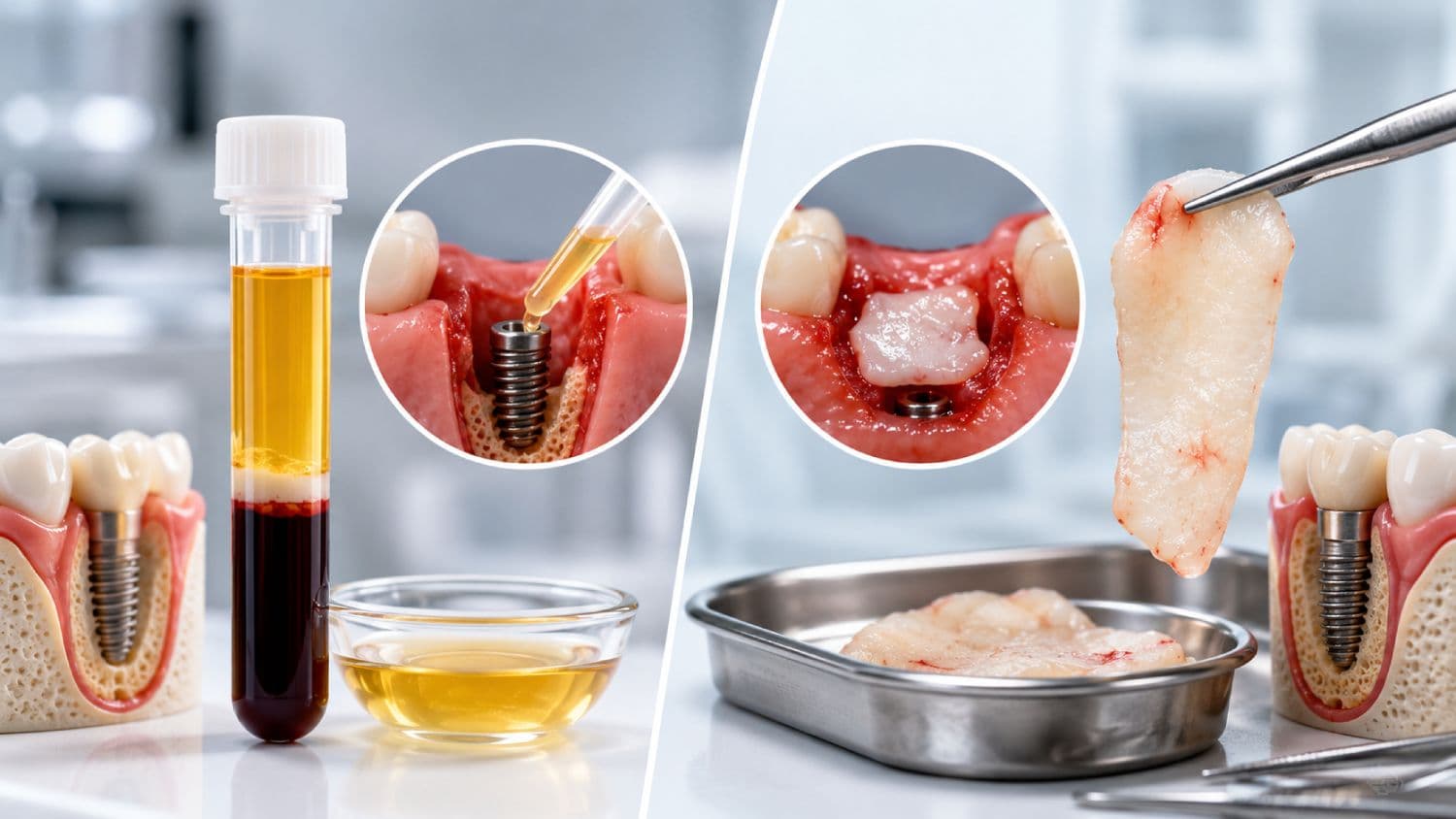
How Is PRP Used During Dental Treatment?
PRP is normally prepared and applied during another dental procedure.
1. Diagnosis and treatment planning
The dentist first determines what treatment is actually needed. PRP should not be the reason to perform an extraction, implant, graft, or periodontal operation that is not otherwise indicated.
The clinician should also review the patient’s medical history, medicines, and factors that may affect bleeding, blood collection, platelet function, or healing.
2. Blood collection
A small venous blood sample is taken. The amount depends on the preparation system and the required concentration. Blood collection and processing should follow appropriate procedures for patient identification, skin disinfection, sterile handling, and equipment use.
3. Processing
The blood is centrifuged according to the selected protocol. The desired fraction is isolated and prepared for application. Because protocols vary, the product name, preparation system, and intended role should be documented when clinically relevant.
4. Application
PRP may be mixed with a graft material, placed in a surgical site, applied around a treated area, or used as part of a specialized regenerative protocol.
It does not replace the essential steps of the underlying treatment. For example:
- An infected site still requires appropriate diagnosis and management.
- An implant still requires suitable positioning and adequate primary stability.
- A bone defect may still require graft material or a membrane.
- Periodontal disease still requires plaque control and indicated periodontal therapy.
- Root-canal treatment still requires appropriate disinfection.
5. Standard aftercare
The aftercare schedule is determined by the underlying procedure, not by the presence of PRP. Patients should not assume that they can load an implant earlier, shorten a healing interval, or travel home sooner simply because a platelet concentrate was used.
Where May Platelet Concentrates Be Used in Dentistry?
Dental implants
PRP has been studied during implant placement and in procedures used to prepare implant sites. The proposed aim is usually to support early wound healing or bone response.
Direct PRP evidence does not establish that it predictably accelerates osseointegration, permits an earlier final restoration, or improves long-term implant survival. Research has produced mixed results, often from small studies, varying preparation protocols, and differing outcome measures.
Implant success depends on many factors that PRP cannot correct, including:
- Diagnosis and case selection
- Bone volume and quality
- Implant position
- Surgical technique
- Primary stability
- Loading protocol
- Prosthetic design
- Hygiene
- Smoking and general health
- Long-term maintenance
PRP should therefore be discussed as a possible adjunct, not as insurance against implant failure.
Bone grafting and sinus-floor augmentation
PRP may be mixed with grafting material during ridge augmentation or sinus-floor procedures. Some studies report favorable early bone measurements, while others find no meaningful difference.
The most important patient outcomes are not limited to one radiographic or laboratory measurement. Patients need to know whether the adjunct improves clinically relevant results such as implant survival, complications, the need for additional treatment, or the final restorative plan.
Current evidence does not establish that adding PRP to sinus-augmentation procedures improves implant survival. It also does not prove that PRP reliably improves the performance of every grafting material.
PRP does not automatically replace a bone graft, membrane, or staged healing period.
Tooth extraction and socket or ridge preservation
Platelet concentrates are sometimes placed in an extraction socket to support clot stability, promote early soft-tissue healing, enhance comfort, or preserve the ridge.
Some studies report favorable early outcomes, but the evidence must be interpreted carefully—much of the stronger recent research concerns PRF or other platelet preparations rather than conventional PRP. Studies also differ in extraction type, socket condition, surgical technique, timing, and outcome measurement.
This means it is not reasonable to promise that PRP will preserve a fixed percentage of bone, prevent every dry socket, eliminate swelling, or halve healing time after an extraction.
The need for socket preservation depends on the reason for extraction, the condition of the socket walls, infection, the future restorative plan, and whether an implant is planned. PRP is only one possible adjunct within that larger decision.
Periodontal treatment
PRP has been investigated as an adjunct in selected periodontal defects. Some research suggests modest improvements in clinical attachment or probing-depth measurements, particularly in surgically treated intrabony defects. The benefit varies according to the defect and the companion treatment.
Evidence for platelet concentrates used with nonsurgical periodontal treatment remains limited and heterogeneous. PRP does not replace daily plaque control, professional subgingival instrumentation, risk-factor management, or periodontal surgery when those measures are indicated.
Regenerative endodontics
PRP and PRF have been studied as biological scaffolds in specialized regenerative endodontic procedures for selected immature permanent teeth with necrotic pulps. The objective is to support continued root development.
This is not the same as adding PRP to routine root-canal treatment in a mature tooth. PRP should not be marketed as a universal alternative to conventional endodontic care.
What Benefits Are Realistic—and What Is Not Proven?
Depending on the procedure and product, realistic possibilities may include:
- An improvement in selected early soft-tissue-healing measures
- Less discomfort or swelling during part of the early recovery period
- A useful adjunctive effect in a carefully selected periodontal defect
- A scaffold for a specialized regenerative endodontic procedure
- A convenient autologous material prepared during the treatment visit
These are possibilities, not promises.
The current evidence does not support universal claims that PRP:
- Reduces dental healing time by 30 to 50 percent
- Increases implant success by a fixed percentage
- Allows every implant restoration to be completed earlier
- Prevents infection or all postoperative complications
- Preserves a fixed percentage of extraction-socket bone
- Eliminates the need for grafting
- Guarantees less pain or swelling
- Makes an unsuitable patient suitable for surgery
- Compensates for weak diagnosis, planning, technique, or aftercare
A statistically significant change in a study is not always large enough to matter to an individual patient. It may also be limited to an early measurement and disappear at later follow-up.
Who Needs Individual Assessment Before PRP?
There is no single checklist that makes PRP appropriate for every dental patient. Suitability depends on both the underlying procedure and the ability to obtain and process an appropriate blood sample.
Tell the dental team about:
- Blood or platelet disorders
- Anemia or known abnormal blood counts
- Unusual bleeding or bruising
- Active infection or serious illness
- Current or recent cancer treatment
- Previous problems with blood collection
- Anticoagulant or antiplatelet medicines
- Anti-inflammatory medicines
- Supplements that may affect bleeding or platelet function
These factors do not all create an automatic prohibition. They do mean that the clinician must assess whether PRP is appropriate, whether tests or medical coordination are needed, and whether the proposed benefit justifies the added step.
Do not stop a prescribed anticoagulant, antiplatelet drug, anti-inflammatory medicine, or other medication to receive PRP unless the treating dentist and prescribing clinician provide a specific coordinated plan.
Stopping medication without medical advice can be more dangerous than omitting the platelet concentrate.
A dentist may also conclude that PRP is unnecessary even when the main dental treatment is suitable.
Risks, Side Effects, and Limitations
Because PRP is autologous, it avoids exposure to donated blood products and reduces some donor-related concerns. That does not make it risk-free.
Possible burdens and risks include:
- Pain from the blood draw
- Bruising or bleeding at the venipuncture site
- Light-headedness or fainting
- Difficulty obtaining an adequate sample
- Preparation or processing failure
- Contamination if collection or preparation controls are inadequate
- Added chair time and cost
- No meaningful additional clinical benefit
Appropriate skin disinfection, sterile collection, controlled preparation, correct labeling, and careful handling remain important.
The normal risks of the underlying dental procedure also remain. PRP does not remove the possibility of postoperative pain, swelling, infection, bleeding, dry socket, graft complications, altered sensation, implant failure, or the need for further treatment.
Contact the treating clinic promptly if you develop worsening rather than improving pain or swelling, fever, persistent bleeding, foul taste or discharge, wound opening, increasing numbness, or another concerning symptom. International patients may need urgent local assessment rather than waiting for a remote reply.
How Much Does PRP Dental Treatment Cost?
There is no meaningful universal price for “PRP dental treatment” because PRP is usually an adjunct to another procedure.
The current published price list for Dr. Furkan Küçük Dental Clinic does not include a standalone PRP fee. An exact clinic price should therefore be derived from an individualized written quotation that identifies the underlying dental procedure and the proposed platelet preparation.
The fee may reflect:
- Blood collection
- A single-use preparation kit
- Centrifugation and processing
- Additional clinical time
- Application of the concentrate
- Documentation or laboratory testing where required
The underlying extraction, implant, bone graft, sinus procedure, periodontal operation, or regenerative endodontic treatment is a separate part of the treatment plan.
A reliable quotation should show PRP as a clear line item or state explicitly that it is included. It should also explain whether it is optional, recommended, or required in that proposed plan.
Do not assume that graft material, membranes, implants, abutments, temporary teeth, final restorations, imaging, medicines, follow-up, hotel, or transfers are included merely because a package uses the words “PRP” or “regenerative treatment.”
Ask what happens to the fee if the blood sample cannot be obtained, the preparation fails, the surgical plan changes, or the clinician decides not to use the concentrate.
Price should not be justified by an unsupported promise of faster healing or a percentage saving compared with another country.
Use the calculator below for an estimate of possible treatment costs. It is not a final diagnosis or quotation.
What a Transparent PRP Quotation Should State
A written dental treatment plan and quotation should answer all of the following:
- What is the diagnosis?
- What is the underlying dental procedure?
- Is the product PRP, PRF, injectable PRF, PRGF, or another preparation?
- Why is it proposed in this case?
- Which realistic outcome is it intended to influence?
- Is the evidence about this exact product and indication?
- Is it optional, recommended, or required?
- What is the alternative without it?
- Who draws the blood?
- Who prepares the concentrate?
- Which dentist or surgeon applies it?
- What is the preparation system or protocol, when relevant?
- What is the separate fee?
- Are blood tests, the processing kit, or other materials charged separately?
- What is included, and what may cost extra?
- What happens if the preparation fails or the treatment changes?
- What follow-up is included?
- Who manages complications, and who pays for remedial care?
This level of detail helps patients compare the scope of treatment rather than comparing an attractive package label with an incomplete quotation.
Planning PRP as an International Dental Patient
PRP should not be used to justify compressing a treatment schedule. The travel plan must follow the extraction, graft, implant, periodontal, or endodontic procedure and the patient’s actual healing.
Before booking travel, clarify:
- How many visits are required
- Which stages must be performed in person?
- Whether the proposed restoration is temporary or final
- What findings could delay the next stage?
- When flying is appropriate after the underlying surgery
- Which follow-up can be performed remotely?
- Which complications require local face-to-face assessment
Before returning home, request:
- The diagnosis and final treatment plan
- Procedure notes
- The exact platelet concentrate used
- Relevant preparation details
- Implant, graft, and membrane records where applicable
- Imaging
- Prescribed medicines
- Written aftercare instructions
- An emergency contact route
The written plan should explain what happens if healing is delayed, a wound opens, infection or bleeding develops, a graft or implant has a problem, or additional care is required after you return home.
PRP does not replace continuity of care.
Individual results may vary.
How to Decide Whether PRP Is Worth Adding
Use the following questions during consultation:
- What exact product are you proposing?
- Why might it help in my particular case?
- Is the supporting evidence about PRP itself or a different platelet concentrate?
- What benefit is realistic, and what is not promised?
- Would you perform the same underlying procedure without it?
- What alternatives are available?
- What is the separate cost?
- Does it change the aftercare or follow-up plan?
- What happens if it is not used?
- Who is responsible if a complication occurs after I return home?
PRP is easier to evaluate when the clinician connects it to a specific diagnosis and measurable objective. It is harder to justify when it is presented as a routine premium upgrade with no clear indication.
Conclusion
Platelet-rich plasma may be useful as an adjunct in selected dental procedures. Still, it is not automatically necessary and is not a universal route to faster healing or better implant outcomes.
The strongest treatment plan begins with the correct diagnosis and appropriate standard care. PRP should then be considered on its own merits: the exact preparation, the specific indication, the quality of supporting evidence, the patient’s medical situation, the added cost, and the follow-up plan.
Choose it because the written plan explains a credible role in your case, not because a package promises “advanced healing” without defining the product, evidence, or responsibility for complications.
Frequently Asked Questions
References
- The use of platelet-rich plasma to enhance the outcomes of implant therapy: a systematic review
- 5th EAO Consensus Conference: platelet preparations in implant-related therapies
- The Effect of Platelet-Rich Plasma on Osseointegration Period of Dental Implants
- Does platelet-rich plasma in sinus augmentation improve dental implant survival? Systematic review and meta-analysis
- Platelet-derived adjuncts to deproteinized bovine bone matrix in maxillary sinus floor elevation
- Platelet-rich plasma in surgical treatment of periodontal intrabony defects
- Autologous platelet-rich concentrates during nonsurgical periodontal therapy
- Autologous platelet concentrates in alveolar ridge preservation
- Platelet-rich plasma versus injectable platelet-rich fibrin
- PRP and PRF in mandibular third molar extraction
- Autologous platelet-rich products in regenerative endodontics
- Microbial contamination risks and clinical safety in platelet-rich plasma therapy
- PRF and PRP in Dentistry: an umbrella review